

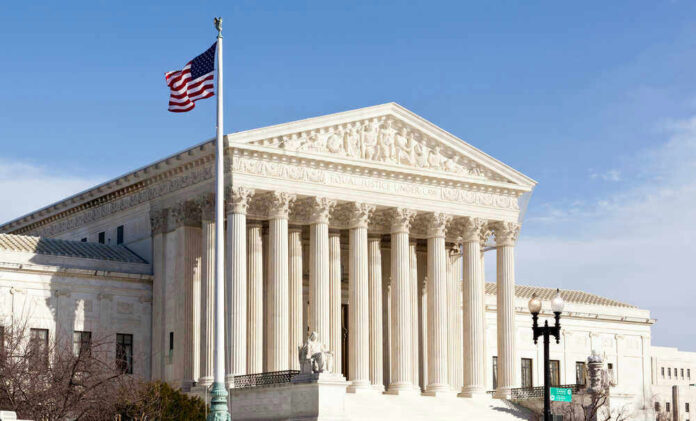
The Supreme Court just handed President Trump and Texas conservatives a major victory that could reshape Congress and drive the left into full panic ahead of 2026.
Story Snapshot
- The Supreme Court reinstated Texas’s pro-Republican congressional map, strengthening Trump’s push to keep GOP control of the House.
- A lower court tried to block the map as “racially discriminatory,” but the justices said it overstepped and disrupted an active election season.
- The new lines could flip up to five Democrat-held House seats in Texas, tightening the GOP’s grip in a high-stakes midterm year.
- Democrats are crying foul while aggressively redrawing their own maps in states like California to target Republicans.
Supreme Court Backs Texas Map
The U.S. Supreme Court revived a redrawn Texas congressional map on December 4, clearing the way for a pro-Republican district plan that a lower court had blocked.
The map was crafted by a Republican-led legislature, signed by Governor Greg Abbott, and strongly backed by President Trump as part of a broader strategy to secure a durable House majority in the 2026 midterm elections. The decision arrives as both parties wage intense redistricting battles nationwide.
The high court’s conservative majority ruled that the lower court interfered improperly in an ongoing primary season and upset the constitutional balance between federal courts and states on election administration.
Justices faulted the earlier ruling for halting the map without requiring challengers to present a workable alternative that still met Texas’s clearly stated partisan goals.
For conservatives, the opinion reinforces the principle that elected state lawmakers, not unelected judges, should primarily control how districts are drawn within constitutional bounds.
US SUPREME COURT REVIVES PRO-REPUBLICAN TEXAS VOTING MAP
(Reuters) – The U.S. Supreme Court revived on Thursday a redrawn Texas electoral map designed to add more Republicans to the U.S. House of Representatives, boosting President Donald Trump's quest for his party to keep… pic.twitter.com/FFvdIYwteP
— FXHedge (@Fxhedgers) December 5, 2025
Impact on Trump Agenda and 2026 Races
The reinstated Texas map is designed to shift as many as five current Democrat-held House seats into the Republican column, a substantial edge when the GOP already holds only slim majorities in Congress.
More Republican seats in Texas could prove decisive in protecting Trump’s legislative agenda from Democrat obstruction and in shielding him from partisan investigations should Democrats regain national momentum.
Every additional conservative district strengthens the firewall against efforts to revive the Biden-era spending, open-border policies, and regulatory overreach that many voters rejected.
Republican leaders in Texas have framed the ruling as a turning point in the fight to “take our country back, district by district, state by state,” arguing that the map reflects the current political climate rather than racial hostility.
They emphasize that redistricting is inherently political and that partisan advantage, by itself, has long been treated differently from unlawful racial discrimination.
For many conservatives, the decision signals that courts will not casually dismantle maps simply because they benefit Republicans, especially when Democrats are using similar tactics in their own strongholds.
Democrat Accusations and Constitutional Claims
Texas Democrats and national progressive groups reacted with outrage, accusing the Supreme Court of abandoning minority voters and gutting hard-won protections from the Voting Rights Act.
They argue that the map punishes Latino and Black voters for how they vote and claim it dilutes their influence by shifting them into districts designed to cement Republican control.
Their criticism casts the ruling as emblematic of a judiciary that, in their view, refuses to confront racial gerrymandering even when civil rights advocates insist the evidence is clear.
Conservatives counter that the lower court’s ruling relied heavily on a Justice Department push to inject race into what Texas officials described as a race-blind process, and that it mislabeled partisan goals as racial discrimination.
They point to longstanding Supreme Court precedent allowing partisan gerrymandering while still forbidding maps driven primarily by race.
From this perspective, the new Texas lines operate within constitutional rules, and the real threat to equal protection comes from federal bureaucrats attempting to force racial quotas into every map-drawing decision.
Nationwide Redistricting Arms Race
While Democrats condemn Texas, their own states are aggressively redrawing maps to entrench liberal power, underscoring that this fight is about raw political control on both sides.
California, heavily Democrat-governed, has moved to reshape districts targeting five Republican-held seats, with voters recently backing a map that heavily favors Democrats.
The Trump administration has already taken legal action against California’s plan, arguing that these new lines represent an overt attempt to rig the game against conservative representation in the nation’s largest state.
Other battlegrounds are emerging, with states like Indiana, North Carolina, Missouri, Florida, Virginia, and Maryland pursuing new maps that shift the balance between the parties. Republicans in Indiana are pushing a plan that would squeeze the state’s only two Democrat House members.
In contrast, Democrat-led states explore ways to blunt GOP gains through their own redistricting strategies. For conservative readers, the apparent reality is that redistricting has become a central front in defending constitutional governance, limiting left-wing overreach, and ensuring that Trump has the congressional backing needed to secure the border, rein in spending, and protect traditional American values.
Legal fights over gerrymandering are not new, but the current cycle builds directly on a 2019 Supreme Court ruling that effectively removed federal courts from policing purely partisan map drawing.
That decision drew a bright line between political advantage, which is allowed, and race-based discrimination, which remains illegal under the Fourteenth and Fifteenth Amendments.
In practice, that framework means state legislatures hold immense power, and conservatives see victories like Texas’s as essential to countering left-leaning judges and activists who try to blur partisan and racial motives to block Republican gains.