A president can survive partisan noise, but not a public that thinks the economy is getting worse every time they swipe a card or fill a tank.
Quick Take
- AP-NORC’s April 2026 poll puts President Trump’s approval on handling the economy at 30%, down sharply from March.
- Gas-price pressure tied to the war in Iran lands as a daily, personal cost—exactly where approval goes to die.
- Cost-of-living management draws especially weak marks, and that weakness shows cracks inside the Republican coalition.
- The “wrong direction” mood remains dominant, making economic messaging harder no matter what the White House claims.
The April 2026 drop: why 30% lands like a trapdoor
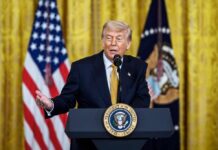
AP-NORC’s April 16–20, 2026 survey shows the president’s economic approval falling to 30% while overall approval slips to the low 30s. Poll numbers move all the time; what matters is where the slide happens.
This one hits the core competence test voters apply to any administration: can you keep the basics stable? When the public says the economy is “poor” in large numbers, the benefit of the doubt evaporates fast.
Older Americans remember plenty of political storms that didn’t matter at the grocery store. This one does. The poll’s direction-of-country numbers signal something more stubborn than a news-cycle dip: a broad sense that the national trajectory feels wrong.
Presidents often try to pivot to employment reports, GDP, or market performance. Voters, especially those living on fixed incomes or tight budgets, grade on what hits the household ledger each week.
Gas prices and the Iran war: the most visible tax in America
The poll’s distinguishing feature is the explicit tie to rising gas prices amid the ongoing war in Iran. Energy costs act like a national metronome: stations post numbers in foot-tall digits, and every commute repeats the message.
Trump's approval on economy falls in AP-NORC poll, showing new warning signs for president https://t.co/efTJmVhEZ2
— The Washington Times (@WashTimes) April 22, 2026
Gas also behaves as an inflation “storyteller.” Even when overall inflation cools, a jump in fuel costs convinces people that everything else will climb next. That expectation changes behavior—less discretionary spending, more credit use, more anxiety—and anxiety becomes political judgment.
The April poll captures that psychological shift. You can argue about the precise share of blame a president owns for global oil markets, but voters don’t outsource accountability.
Cost of living: where Republican unity starts to fray
The cost-of-living numbers stand out as a warning beyond normal partisan sorting. Only about a quarter approve of the president’s handling of living costs, with broad disapproval overall.
That’s the measure tied most directly to how people feel about leadership competence, because it translates policy into pain. When prices rise, voters don’t debate macroeconomic models; they ask why their paycheck buys less and who seems serious about it.
The poll also flags an uncomfortable dynamic for Republicans: division within the party coalition, particularly among younger Republicans who express greater dissatisfaction with costs.
That matters because younger voters aren’t just “future voters”; they’re current mortgage applicants, parents buying groceries, and workers watching insurance premiums.
A governing message works when it pairs strong borders and national security with disciplined stewardship of household economics. Lose the second, and the first stops carrying elections.
How we got here: a second-term economy that never earned trust
The deeper context in AP-NORC’s tracking is grimly consistent: large majorities have described the economy as poor across multiple polls spanning late 2024 through 2025, with April 2026 intensifying that pessimism.
That continuity matters because it suggests the public isn’t reacting to one headline; they’re living through a long affordability hangover. When a presidency inherits inflation scars, it needs visible progress quickly, or the narrative hardens into permanent distrust.
AP-NORC’s earlier snapshots show the president running stronger on immigration than on the economy, a pattern that still shapes his coalition. That can win primaries and even general elections, but governing requires more than one strong issue. The economy is the “all-weather” measure; it decides whether persuadable voters and soft partisans tolerate controversy. When economic approval hits its lowest point of the term, every other initiative becomes harder to sell.
What the numbers mean politically: accountability beats spin
Partisanship still frames the approval map, with Republicans far more approving and Democrats and independents heavily disapproving. That’s modern America.
The practical question is whether the president can persuade even a sliver of independents that the administration has a credible plan. The April decline suggests slippage inside the coalition is possible when prices climb. Elections often turn on enthusiasm and turnout, not conversions.
A lens doesn’t require pretending markets are fully controllable by any White House. It does require expecting competence: reducing self-inflicted uncertainty, protecting domestic energy capacity, avoiding messaging that insults voters’ lived experience, and prioritizing policies that expand supply and restrain costs.
If the administration can’t articulate a believable affordability strategy while the Iran war keeps energy markets jittery, the poll’s “warning signs” look less like noise and more like a forecast.
Older voters have seen politicians survive scandals, gaffes, and cultural fights. Few survive a sustained sense that the country feels expensive, unstable, and headed in the wrong direction.
The open question isn’t whether approval bounces a point or two next month. It’s whether the administration can change how people feel while waiting in line at the gas station and at the checkout. Until that changes, the numbers will continue to tell the same story.
Sources:
Fewer approve of Trump’s handling of the economy
Trump’s approval rating slips on the economy and immigration
Trump scores better marks with the public on immigration than the economy