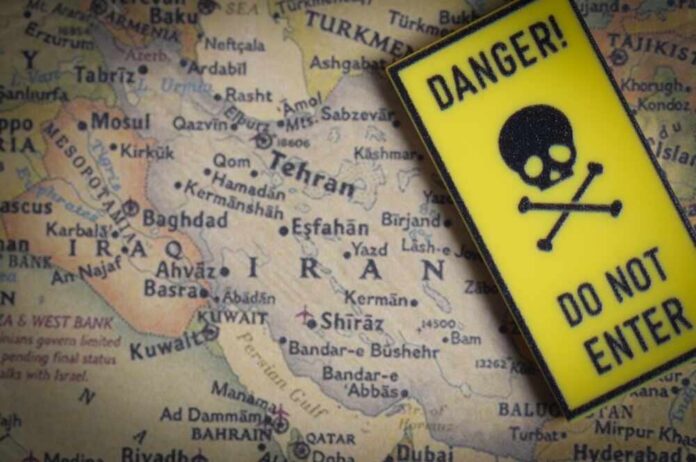
Iran’s biggest missile barrage on Qatar is a blunt reminder that Tehran’s war strategy is to drag America’s allies—and global energy supplies—into chaos.
Story Snapshot
- Iran launched its largest reported barrage on Doha, Qatar, as the Israel-Iran war widened across Gulf states hosting or supporting US forces.
- Qatar condemned the strike as a sovereignty violation, while Iran’s foreign minister claimed the operation targeted US interests—not Gulf countries.
- Israel reported major gains against Iran’s air defenses and missile launchers, while warning the threat is not yet removed.
- The Strait of Hormuz disruption stranded shipping and pushed oil above $100, exposing how quickly Middle East conflict hits American wallets.
Iran Expands the Battlefield to Gulf States
Iran fired what was described as its biggest barrage on Qatar’s capital, Doha, with explosions reported and air defenses intercepting incoming missiles.
The strike came as Israel carried out fresh attacks on targets in Tehran, Qom, and Isfahan, intensifying a conflict that began February 28. Gulf states that host US military facilities—once treated as “buffer” territory—now face direct fire, raising the risk of broader regional escalation.
🚨JUST IN: Secretary of War Pete Hegseth just said today will be the US military's MOST intense day of strikes against Iran:
"Today will be yet again our most intense day of strikes inside Iran. The most fighters, the most bombers, the most strikes. Intelligence more refined and… pic.twitter.com/6ViXqsBKnx
— Morse Report (@MorseReport) March 10, 2026
Qatar’s leadership publicly condemned the attack as a “flagrant violation,” signaling that Iran’s claim of precision targeting is not persuading the countries being hit. Iran’s foreign minister, Abbas Araghchi, argued the strikes were aimed at US interests, not Gulf neighbors.
That explanation clashes with the reality that missiles and drones flying into Gulf airspace inevitably endanger civilians, infrastructure, and regional stability—especially around major energy and aviation hubs.
Israel Claims Air Superiority While Warning the Fight Isn’t Over
Israeli military leaders said Israeli operations severely degraded Iran’s integrated air defenses and struck a large share of its missile launchers, attributing a reported drop in Iranian barrages toward Israel to those losses. Even with those gains, Israel’s top commander cautioned that the threat remains and hinted at further “surprises.”
The practical takeaway is that air superiority does not instantly end missile warfare, particularly when Iran can adapt with dispersed launch sites and proxy support.
Hormuz Shock: The Energy Chokepoint Becomes a Weapon
Iran’s threats against the Strait of Hormuz rapidly moved from rhetoric to disruption, with ships reported stranded and a major portion of global oil trade jeopardized.
The conflict-driven risk premium sent oil prices above $100, demonstrating how overseas instability can translate into higher costs for transportation, heating, and groceries back home. For Americans still fed up with the inflationary mess of the mid-2020s, the lesson is clear: energy security is national security.
US Military Pressure Meets Iran’s Chaos Strategy
US involvement under President Donald Trump has unfolded alongside congressional authorization for continued action, while US naval forces reportedly sank Iranian warships amid the widening confrontation. Iran also claimed to have struck a US tanker in the Persian Gulf, though the broader reporting notes limits on independent confirmation.
Analysts cited in reporting describe Tehran’s approach as spreading fear and uncertainty across the region—using missiles, drones, and threats to choke commerce—even when outgunned in conventional airpower.
What’s Confirmed, What’s Disputed, and Why It Matters
Multiple sources align on the war’s start date, the March 5 Doha barrage, and the pattern of strikes expanding across Gulf states. Reporting also highlights uncertainty points: Iran’s denial of targeting Gulf countries despite impacts on their territory, disputed or uneven casualty figures, and the difficulty of verifying claimed hits in a fast-moving battlespace.
Separately, outlets warned that fake videos circulated during the conflict, underscoring why readers should demand confirmed details before accepting viral narratives.
For US readers, the central issue is not punditry—it’s the real-world chain reaction: missiles hitting allied capitals, shipping disrupted at a global chokepoint, energy prices spiking, and the constant risk of a miscalculation pulling more nations into open war.
The conflict also tests whether regional partners can deter attacks while maintaining sovereignty, and whether decisive military gains translate into durable security instead of a rolling cycle of retaliation.
Sources:
Iran claims it hit US tanker as Israel launches fresh strikes on Tehran
Iran Update: Evening Special Report, March 3, 2026
Middle East Special Issue, March 2026
Iran’s barrage of attacks across Persian Gulf shows regional chaos key to its strategy