

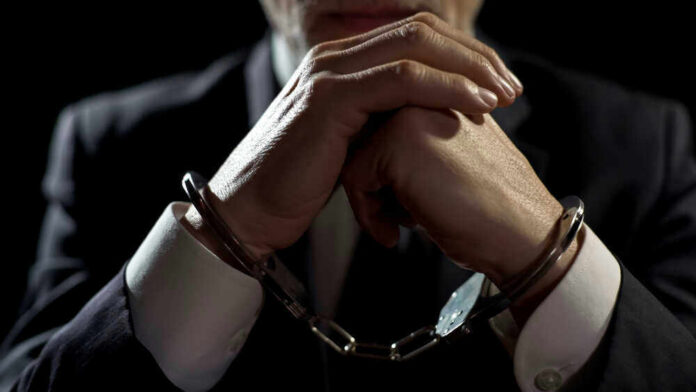
A defense attorney’s arrest inside a courthouse hallway just blew up a murder trial that had already dragged on for six years.
Story Snapshot
- A Stanislaus County judge declared a mistrial in Kelley Marie Ball’s Modesto DUI-murder case after her defense attorney vanished mid-trial.
- Attorney Christopher Loethen, 50, was arrested at the courthouse on suspicion of drug possession, being under the influence, and public intoxication.
- He failed to show up in court or answer calls and emails for two straight days after his arrest.
- Judge Valli Israels ruled the mistrial “without prejudice,” clearing the way for a new trial.
What Happened Inside the Stanislaus County Courthouse
Sheriff’s deputies arrested Christopher Loethen around noon on September 16 while he was working the Modesto murder case.
Stanislaus County Sheriff’s Sergeant Michael Carranza told The Fresno Bee that Loethen was booked into the Stanislaus County Public Safety Center on suspicion of possession of a controlled substance, being under the influence of a controlled substance, and public intoxication.
Shocking twist in California murder case as suspect's attorney arrested in court https://t.co/oosbpIfYet pic.twitter.com/w5czkJC0Rk
— New York Post (@nypost) September 20, 2026
The case he was defending was not a minor one. Kelley Marie Ball faces charges tied to a DUI-related killing, a case that had already stretched six years before ever reaching this trial.
Losing lead counsel mid-proceeding is a serious problem for any defendant, but especially one facing a murder charge with years of legal maneuvering already behind it.
Two Silent Days Force the Judge’s Hand
Loethen didn’t just miss one court date. He failed to appear Thursday and Friday, and the court could not reach him by phone or email for two full days.
A murder trial cannot simply pause indefinitely while the defendant’s own lawyer goes dark. Judge Valli Israels was left with no functioning defense counsel and a jury waiting in the box.
Faced with that vacuum, Israels declared a mistrial without prejudice on Friday. That legal phrase matters. It means prosecutors keep the right to retry Ball, and the case isn’t thrown out, it simply resets. For the victim’s family and for Ball herself, six years of waiting just added another chapter with no end date yet in sight.
Why Courts Don’t Take Attorney Incapacity Lightly
Judges don’t declare mistrials over minor hiccups. The legal standard generally requires “substantial and irreparable prejudice” to the defendant’s case before a mistrial is warranted.
An attorney who is arrested, jailed, and then unreachable for two days during an active murder trial checks that box about as clearly as a fact pattern can.
California courts have also wrestled for years with what happens when defense counsel’s own conduct undermines a fair trial. In one notable case, the state Supreme Court found that a defense attorney’s failure to properly investigate key evidence was “objectively unreasonable and prejudicial” to the defendant.
That case involved a different kind of failure, but it underscores the same principle: a defendant’s fate should not hinge on whether their lawyer showed up capable of doing the job.
A Case That Was Already Six Years in the Making
What makes this mistrial sting more is the timeline. A DUI-murder case that took six years to reach trial now starts the clock over, at least in part.
Evidence has to be revisited, witnesses may need to testify again, and a new defense attorney has to get up to speed on a case that’s been alive since before the pandemic reshaped court calendars nationwide.
The Stanislaus County District Attorney’s Office has not signaled it intends to drop the case, and a mistrial without prejudice all but guarantees a retrial will follow.
For now, the courthouse arrest of one attorney has cost the system years of progress on a single case, and left a defendant’s future once again undecided.
Sources:
nypost.com, fresnobee.com, law.justia.com, caselaw.findlaw.com, michbar.org