The Supreme Court just handed President Trump a powerful tool to finally control chaos at the southern border.
Story Snapshot
- Supreme Court rules 6-3 that migrants stopped on Mexican soil have not “arrived in” the United States and cannot demand asylum screening yet[7].
- The decision clears the way for the Trump administration to revive the metering policy to prevent overcrowding at border facilities[1][7].
- Justice Samuel Alito’s opinion relies on plain language, saying a person has not arrived until they actually enter the country[7].
- Liberal justices and activist groups blast the ruling as “devastating,” signaling a new round of political and media attacks[5].
Supreme Court backs Trump on asylum and border control
The United States Supreme Court ruled 6-3 that migrants turned back while still standing on Mexican soil have not “arrived in” the United States and therefore are not yet entitled to claim asylum under federal law[7].
In simple terms, if you have not physically crossed into the country, you cannot force American officers to start full asylum processing.
The case Mullin v. Al Otro Lado gives the Trump administration legal clearance to manage border flows rather than be overwhelmed day after day[7].
The challenged practice, known as the metering policy, limits the number of people who can initiate asylum claims at ports of entry each day when facilities are overloaded[1][7].
This policy began under President Obama and was expanded during President Trump’s first term, but lower courts later blocked it as unlawful [1][7].
Now the Supreme Court has overturned those rulings, removing the main legal roadblock. The administration still must decide when and how to restart the policy, but the constitutional path is open again[1][5][7].
Majority focuses on plain meaning of the law
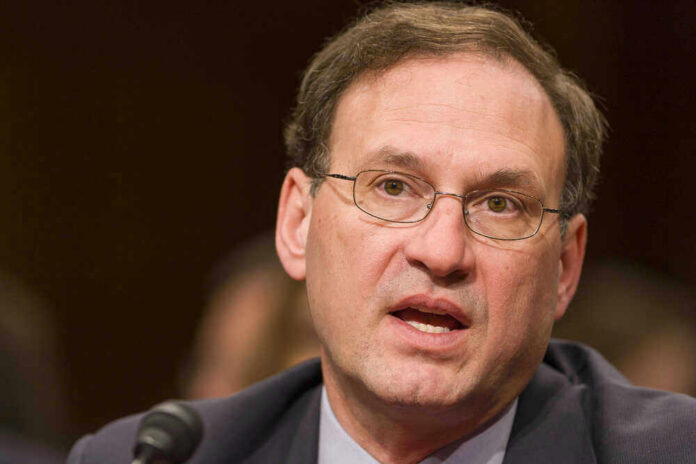
Justice Samuel Alito wrote for the conservative majority that federal law only protects migrants who “arrive in the United States,” and “arrive in” requires actual physical entry[7].
He explained that in normal speech, no one says that a person arrived at a house or in a country before walking inside [7].
The Justice Department had argued the same point, saying officers at the border do not have to process asylum claims for people they stop before the border, because those people are not yet in the United States[2][7].
Reporters covering the decision note this reading is based on a straightforward view of the statute rather than creative legal theory[6][7].
For many conservatives, that matters. It means the Court is enforcing the law as written by Congress, not as stretched by activist judges or advocacy groups.
It also restores what Trump officials call a “critical tool” to handle border surges and protect already strained facilities and communities from being pushed past the breaking point[7].
Dissent and media push back against the ruling
Liberal Justice Sonia Sotomayor, joined by Justices Elena Kagan and Ketanji Brown Jackson, filed a fierce dissent and warned the ruling would hurt vulnerable people fleeing danger[5].
She argued that speaking with a Border Patrol agent at a port of entry is the first step in “arriving” in the United States and claimed the majority was too focused on narrow word meanings[3][5].
Activist groups like the American Immigration Council quickly said the decision “effectively overturns” a century of practice requiring inspection of everyone who presents themselves at ports of entry[1].
President Trump’s America First Agenda Scores Major Supreme Court Win on TPS Termination
FOR IMMEDIATE RELEASE
The Supreme Court has delivered a major victory for American sovereignty, ruling that the Trump Administration has full authority to terminate Temporary Protected…
— White House Press Pool Reports (@WHPressPool) June 26, 2026
Mainstream outlets amplified those criticisms, calling the ruling “devastating” and a “blow” to immigrant and asylum rights[5]. That framing tries to paint any serious enforcement step as cruel, even when it simply restores basic border control.
What many of these critics do not address is the strain on local schools, hospitals, law enforcement, and charities when endless waves of migrants are waved through without limits. The Court’s decision shifts the debate back to whether the United States has the right to control who enters and when [7].
What the decision means for Trump’s agenda and border communities
For the Trump administration, this ruling is a major immigration victory that fits into a broader America First agenda to secure the border and restore the rule of law[7]. It confirms that the executive branch can temporarily slow intake at crowded ports rather than pretend infinite capacity exists.
For border states like Texas and Arizona, that legal backing may help officers and communities avoid the dangerous bottlenecks and security gaps they faced during past surges, when inspection lines stretched for hours and facilities overflowed [7].
Critics warn that fewer people will gain quick access to the asylum system, but the law still allows migrants to apply once they are physically inside the country and meet the legal standards for persecution[2][7].
The ruling does not erase asylum; it clarifies when those protections start. For conservatives worried about open borders, this is a key distinction.
The United States can offer refuge to people truly in danger while still insisting that entry happens in a controlled, lawful way that respects national sovereignty, local resources, and the safety of American families[2][7].
Sources:
[1] Web – Supreme Court clears way for Trump administration to revive …
[2] Web – In Blow to Asylum Rights, Supreme Court Allows Trump …
[3] Web – Supreme Court rules for Trump on asylum claims at the border
[5] YouTube – In “Devastating” Immigration Ruling, Supreme Court Allows Trump …
[6] Web – East Bay Sanctuary Covenant v. Trump
[7] YouTube – Supreme Court immigration decision allows Trump to …