Six American reservists were killed by an Iranian drone strike—forcing the country to confront, once again, the real human cost of Middle East escalation.
Story Snapshot
- President Donald Trump attended a dignified transfer at Dover Air Force Base on March 7, 2026, honoring six U.S. Army Reserve soldiers killed in Kuwait.
- The troops—assigned to the 103rd Sustainment Command—died after an Iranian drone hit a U.S. command center in Port Shuaiba, Kuwait, following U.S.-Israel strikes on Iran.
- Vice President JD Vance and Defense Secretary Pete Hegseth joined Trump and the families for the solemn military ritual.
- The deaths mark the first reported U.S. fatalities in the current Iran conflict, highlighting risks to more than 40,000 U.S. troops deployed across the region.
Dover Transfer Marks First U.S. Losses in the Current Iran Conflict
President Donald Trump traveled to Dover Air Force Base in Delaware on Saturday, March 7, 2026, to attend the dignified transfer of six U.S. Army Reserve soldiers killed in Kuwait.
The troops, assigned to the Iowa-based 103rd Sustainment Command, died when an Iranian drone struck a U.S. command center in Port Shuaiba. The White House announced the trip the prior day as the war’s first American deaths came into focus.
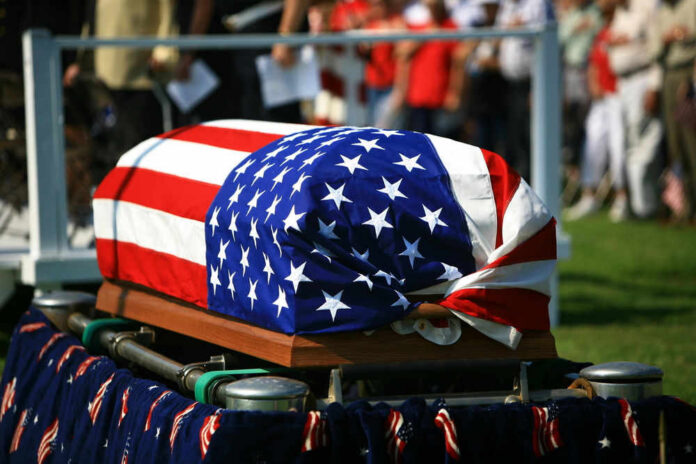
The dignified transfer is a military ritual, not a political rally. Service members from the same branch move flag-draped transfer cases from the aircraft to the mortuary, where remains are identified and prepared for return to families.
Dover has been the primary site for these transfers since 2003, as the U.S. faced casualties in Iraq and Afghanistan. Trump has previously described this duty as among the hardest a commander-in-chief must carry out.
Who the Fallen Were—and Why a Logistics Unit Was in the Crosshairs
Reporting identified the fallen as five men and one woman, ranging in age from 20 to 54, a reminder that reserve service spans young adults and seasoned professionals.
The soldiers included Maj. Jeffrey O’Brien, Chief Warrant Officer Robert Marzan, Capt. Cody Khork, Sgt. 1st Class Nicole Amor, Sgt. 1st Class Noah Tietjens, and Sgt. Declan Coady. Their unit’s role—sustainment—underscores that modern warfare targets supply and command nodes, not only front-line forces.
The strike also illustrates a strategic vulnerability: logistics hubs keep forces operating by moving food, fuel, and ammunition, and they can become prime targets when a conflict expands. Coverage tied the attack to a broader U.S.-Israel campaign against Iran that began days earlier, followed by Iranian retaliation.
The sequence matters because it frames the deaths not as an isolated incident, but as part of a fast-moving escalation with predictable responses and counter-responses.
Trump grieves with families during return of soldiers killed in war in Middle East https://t.co/anZIULDomT
— Dallas Morning News (@dallasnews) March 8, 2026
Trump, Vance, and Hegseth Present as Families Shoulder the Burden
Video coverage from the ceremony showed Trump joined by Vice President JD Vance and Defense Secretary Pete Hegseth, standing with grieving families during the transfer.
The visual is significant because it places the commander-in-chief and senior leadership alongside the people who pay the most personal price when war expands: parents, spouses, and children. In this case, the families were tied to communities in Iowa, where reserve units often have deep local roots.
The White House described the soldiers as victims of Iran’s “opening salvo,” a phrase that signals officials expect more attacks. While immediate reporting did not confirm additional casualties in the days right after the transfer, the broader operational picture remains dangerous.
U.S. bases and partner facilities across the region have long faced threats from drones and missiles, and the latest deaths make clear that even non-combat specialties can be exposed in a high-tech battlefield.
What This Moment Signals About the War—and the Limits of What’s Known
Public attention typically surges when American deaths are confirmed, and this transfer is likely to intensify scrutiny of objectives, risk management, and force protection for Americans stationed overseas.
The research available so far is strongest on the core facts—who was killed, where, and when, plus who attended the transfer—while offering fewer confirmed details about the precise operational circumstances beyond the drone strike on the command center. That limitation makes careful, fact-based analysis essential as the conflict continues.
For many voters who watched prior administrations drift into global commitments while problems piled up at home, the Dover ceremony is a sobering reminder that “forever war” isn’t a slogan—it’s a flag-draped case and a family left behind.
At the same time, the strike highlights why deterrence, border security at home, and constitutional governance matter: citizens expect leaders to prioritize American lives, avoid careless escalation, and remain accountable to the people when the costs of conflict become unavoidable.
Sources:
Trump to Attend Return of Six US Troops Killed in Iran War