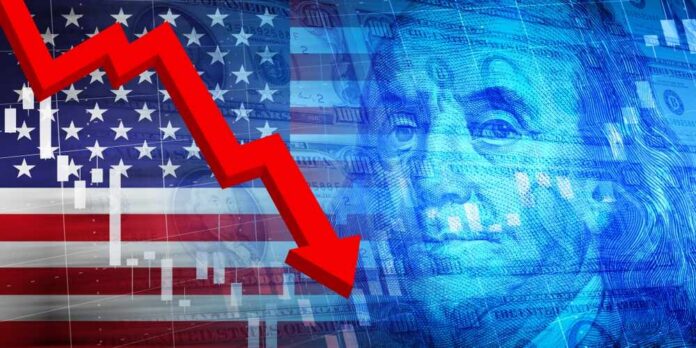
Wall Street’s most reliable recession indicator is flashing red for the first time in years, yet mainstream analysts refuse to acknowledge what the data plainly shows—hardworking Americans may be heading toward an economic storm.
Story Snapshot
- Unemployment chart with 100% recession accuracy since 1950 signals potential downturn ahead despite Wall Street optimism
- Polymarket traders place 35% odds on recession by year-end 2026 as labor market shows worrying cracks beneath surface strength
- Fed policy and tariff-driven inflation threaten to push CPI back to 3.6% mid-year, squeezing household budgets further
- Hiring slowdowns and sluggish job openings contradict rosy GDP numbers, revealing disconnect between official data and ground-level reality
Historic Indicator Contradicts Establishment Consensus
Société Générale strategist Albert Edwards unveiled a labor market chart demonstrating the unemployment rate crossing above its three-year moving average, a pattern that has preceded every recession since 1950 with perfect accuracy.
Edwards emphasized that despite zero mainstream forecasters predicting a 2026 recession, this indicator’s flawless track record across eight economic downturns cannot be ignored.
The unemployment rate reached 4.6% in November 2025, and hiring activity remains sluggish even as GDP figures show surface-level resilience.
This divergence between official growth statistics and deteriorating labor fundamentals mirrors the disconnect many Americans experience between Washington’s economic cheerleading and their own financial struggles.
Goldman Sachs just raised US recession odds to 30%, the third bump in 90 days.
Growth is slipping below potential, oil is stuck around crisis levels, and credit is tightening into a weakening jobs market.
This is what the start of a recession actually looks like in real time.…
— StockMarket.News (@_Investinq) March 24, 2026
Labor Market Weakness Threatens Main Street Families
Job openings have declined substantially, while hiring remains anemic, creating mounting pressure on households already battered by years of inflation driven by reckless government spending.
The labor market slowdown poses the primary threat to stock portfolios and retirement accounts, yet major banks like J.P. Morgan and Goldman Sachs project continued growth, forecasting 2.2% to 2.8% expansion.
These optimistic Wall Street projections ignore ground-level warning signs familiar to ordinary Americans: reduced hiring, stagnant wages, and persistent cost-of-living challenges.
The Sahm Rule, which quantifies recession risk through unemployment trends, issued its first false positive in August 2024, but current labor deterioration suggests the indicator may prove accurate this time around despite earlier misfires.
Policy Distortions Cloud Economic Reality
Federal Reserve rate cuts totaling 50 basis points anticipated for 2026 may prove insufficient if tariff policies drive inflation back toward 3.6% by mid-year, then cool to 2.2%, according to J.P. Morgan forecasts.
Policy shifts from the current administration, including tariffs and fiscal stimulus measures, create data distortions that obscure true economic conditions and complicate monetary policy decisions.
This environment of mixed signals—euphoric stock markets contrasted with dismal consumer confidence—reflects the schizophrenic nature of an economy propped up by government intervention rather than organic private-sector strength.
Stanford economists project stable unemployment near 4.6% with modest job growth, but prediction market Polymarket shows traders pricing in 35% odds of a recession by year-end 2026, revealing genuine concern beneath official reassurances.
Recession odds climb on Wall Street as economy shows cracks beneath the surface. The economy last year lost more than half a million jobs excluding health care. https://t.co/EtRBaEwfsx
— Jeff Cox (@JeffCoxCNBCcom) March 25, 2026
Economic Storm Ahead for Ordinary Americans
Working families face dual threats from potential recession and renewed inflationary pressures, with J.P. Morgan projecting longer-term growth deceleration to just 1.7% in 2027 without continued stimulus.
The so-called “misery index,” which combines unemployment and inflation, currently stands at 7.3%, better than 76% of the past 50 years, yet this statistical comfort provides little solace to households struggling with elevated prices and uncertain job prospects.
Edwards warns that equity markets face their biggest risk from a labor-driven recession rather than the financial crises that precipitated previous downturns, a distinction that matters little to retirees watching nest eggs potentially evaporate.
Conservative Americans understand what elites refuse to acknowledge: endless deficit spending, pointless foreign wars draining resources, and economic manipulation create fragile prosperity that crumbles when reality intrudes on government fantasies.
Sources:
One Chart Shows Why a Recession Could Still Be in the Cards in 2026
US Recession by End of 2026 – Polymarket
A Baseline Forecast for 2026 – J.P. Morgan Asset Management
The US Economy in 2026: What to Watch – Stanford SIEPR