

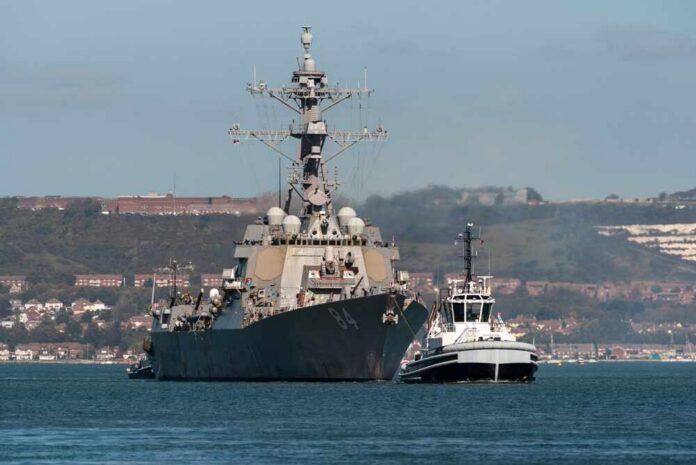
A Navy destroyer sat dead in the water for four days in one of the most contested stretches of ocean on Earth, its sailors rationing water and enduring no air conditioning while engineers scrambled to bring the ship back to life.
Quick Take
- The USS Benfold lost all power on July 24 after an “engineering casualty” tied to its generators, according to the Navy’s 7th Fleet.
- Sailors went four days without working toilets, air conditioning, regular meals, or potable water while the destroyer drifted in the South China Sea.
- No crew injuries were reported, and the ship was towed to Subic Bay in the Philippines for repairs.
- The incident is the second major power failure on a Navy destroyer in the Indo-Pacific this year, following a May outage on the USS Higgins.
A Warship Goes Dark In Disputed Waters
The USS Benfold, an Arleigh Burke-class guided-missile destroyer, was sailing with the USS George Washington Carrier Strike Group when the power failure hit on July 24.
A 7th Fleet spokesman, Commander Matthew Comer, said the ship suffered an engineering casualty involving its generators that caused a total power loss lasting four days.
The South China Sea is not a friendly place to lose steering and radar, given the heavy naval traffic and disputed territorial claims that run through it.
Losing power on a warship means losing almost everything that keeps a crew functioning. Toilets stopped working. Air conditioning shut down in tropical heat. The galley could not cook regular meals, and the ship’s supply of clean drinking water ran short.
Other vessels in the strike group had to ferry food to the stranded destroyer while its own engineers worked around the clock to diagnose the failure and restore basic systems.
No Injuries, But A Ship That Could Not Move Or Fight
Commander Comer said no sailors were hurt during the ordeal and praised the crew’s “resilience, grit, professionalism and unwavering steadiness” while they worked through the crisis. That is a credit to the sailors.
But a warship that cannot maneuver, cannot run its radar properly, and cannot defend itself for four straight days in a region where the Chinese navy operates constantly is a serious readiness problem, not just an uncomfortable inconvenience for the crew.
The Benfold was eventually towed to Subic Bay in the Philippines, where repair crews restored power and fixed the generator system. The Navy has not released a root cause for the failure and says the matter remains under investigation.
“Engineering casualty” is the Navy’s catch-all term for equipment breakdowns, and it does not by itself explain whether the problem stemmed from worn parts, a maintenance backlog, or something else entirely.
This Is Not An Isolated Incident
The Benfold’s breakdown is the second major destroyer power failure in the Indo-Pacific this year. In May, the USS Higgins suffered its own electrical casualty and lost power and propulsion for several hours after an internal fault forced a shutdown of its entire electrical grid.
Two similar failures on front-line destroyers within a few months of each other is not a coincidence readers should ignore, even without a formal pattern being declared by the Navy itself.
Government audits have flagged strain on the Arleigh Burke-class fleet for years. The Congressional Budget Office estimated these destroyers will spend up to 27 percent of their planned service lives tied up in overhauls and maintenance.
A Pentagon inspector general audit previously tied a string of Arleigh Burke casualties to sailor deaths and equipment damage, underscoring how mechanical failures on these ships are not new, even if each incident draws fresh alarm.
After a complete loss of power on the USS Benfold, sailors on board went four days with limited drinking water, and no working toilets or air conditioning.
https://t.co/S1qbQP6gpU— Central Oregon Daily News (@CODaily) August 19, 2026
None of this means the Navy is falling apart, and it would be wrong to treat one generator failure as proof of collapse. But taxpayers spend billions keeping this fleet at sea, and sailors deserve equipment that does not leave them sweating without toilets in waters where rivals are watching.
Congress and Navy leadership owe the public a clear accounting of why generator failures keep sidelining front-line ships, and what is being done to fix it before the next deployment, not after.
The investigation into what exactly failed aboard the Benfold is still open. Until the Navy names a root cause, the responsible position is to take the reported facts at face value: a warship went dark for four days, sailors toughed it out without basic comforts, and the fleet’s maintenance record just picked up another entry that will not be forgotten quickly.
Sources:
cbsnews.com, stripes.com, cnn.com, facebook.com, usni.org, timesofindia.indiatimes.com