
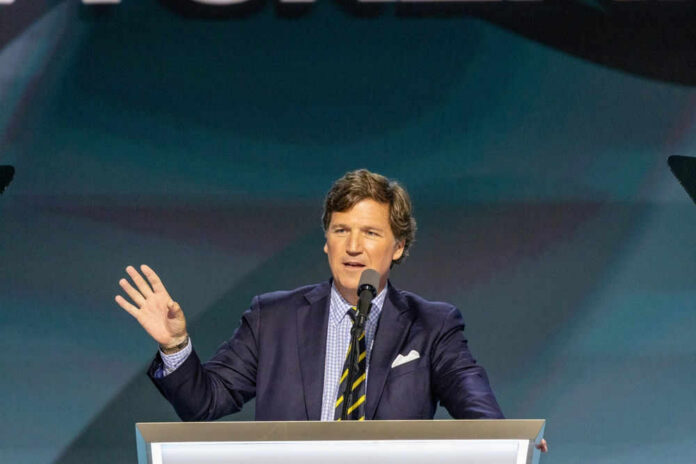
Poland’s embassy says Tucker Carlson crossed a bright moral line by echoing Adolf Hitler’s case for invading Poland.
Story Snapshot
- Poland’s envoy in Washington demanded a public retraction and apology from Tucker Carlson.
- The embassy accused Carlson of falsifying World War II history and insulting victims of Nazism.
- Reports quote Carlson saying Hitler’s invasion of Poland was not unprovoked and that Britain had no reason to fight.
- The clash spotlights how “history wars” spill into modern diplomacy and media cycles.
Poland’s Diplomatic Line In The Sand
Poland’s chargé d’affaires, Bogdan Klich, issued a written demand to Tucker Carlson: retract and apologize. Klich said Carlson “became an apologist for Adolf Hitler,” and accused him of “completely falsifying the documented historical record.” The letter framed the remarks as a denial of Nazi aggression and a “colossal insult” to victims. The Polish Embassy posted the demand publicly, signaling that Warsaw wanted no ambiguity about its stance.
Public rebukes from embassies are rare, but not unheard of. This one was blunt and direct. The message: no mainstream platform should launder the talking points Adolf Hitler used to justify war. Poland’s case rests on a fixed baseline. Nazi Germany launched a war of conquest against a sovereign neighbor in 1939. Attempts to dress that invasion in grievance claims do not change the act or the intent. The letter places that red line front and center.
What Carlson Said, And Why It Lit The Fuse
Coverage of Carlson’s interview with Jacob Rees-Mogg quoted him saying, “the idea that Hitler just randomly rolled into Poland is a lie.” He cited Hitler’s claim that parts of Poland had once been German after the First World War and said, “by the way, that was true.” He also dismissed Britain’s defense of Poland, saying the United Kingdom “had nothing to do with it at all.” Those remarks triggered the Polish response and a wider backlash.
The evidentiary record here includes press quotes and summaries, not the full unedited interview. That limits context. Still, the lines cited are specific and striking. They elevate the Nazi dictator’s stated case and frame the invasion as something other than naked aggression. Poland’s response targeted that framing, not a stray aside. The embassy argued that repeating a tyrant’s rationale while ignoring his actions misleads the public about why World War II began.
The Historical Bottom Line And The Values Test
Hitler’s complaint about borders after the First World War existed. So did his orders to crush Poland. One does not justify the other. American conservative values draw a clear distinction between grievance and aggression. Borders change by treaties, not tanks. Nations defend allies because deterrence works only if promises mean something. Britain honored its security pledge to Poland and resisted a dictator who had already smashed treaties across Europe. That choice aligns with moral clarity and common sense.
POLAND DEMANDS TUCKER CARLSON APOLOGIZE OVER WWII REMARKS
Poland’s Chargé d’Affaires in Washington, @BogdanKlich, has called on @TuckerCarlson to publicly retract and apologize for remarks made in his conversation with Sir Jacob Rees-Mogg about the outbreak of World War II.… pic.twitter.com/8h5mOzDzTt
— Mossad Commentary (@MOSSADil) October 6, 2026
Poland’s case rests on established facts: Nazi Germany attacked Poland in September 1939, triggering Allied war declarations. The embassy’s letter insists that public figures should not repackage the invader’s talking points as facts that change the moral ledger. That argument is strong because it matches the record of conquest, occupation, and atrocity that followed. Carlson’s critics are not nitpicking semantics. They are defending the basic truth that cause-making by a tyrant is not a defense for invasion.
Why This Fight Escalated So Fast
The dispute shows how media provocations turn into state-level pushback. A viral clip rewards shock lines. A government must guard national memory and the dignity of its dead. Those roles collide. Poland answered in public to prevent drift from fact into spin. The blowback also reflects a larger pattern: pundit claims about World War II often become litmus tests for whether we still believe strength should check aggression before it spreads across continents.
Sources:
jfeed.com, tvpworld.com, poland-24.com, polskieradio.pl, ua.news, wiadomosci.onet.pl, unherd.com