

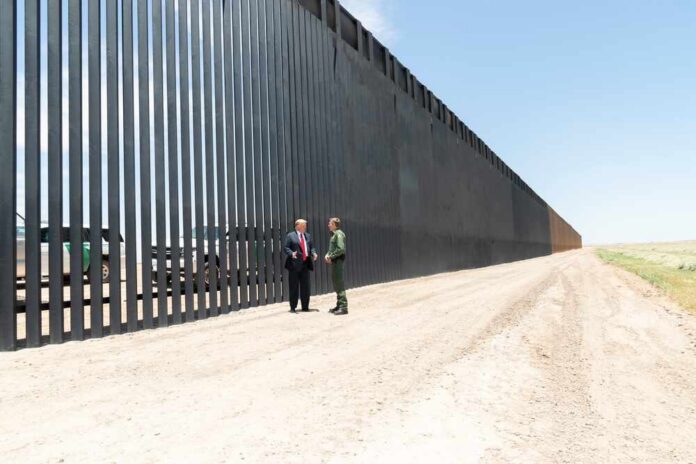
A federal judge hit pause on Big Bend border wall work, and the fight now turns on whether the law was stretched past its limit.
At a Glance
- A federal court issued a temporary halt on border-barrier construction in Texas’ Big Bend region.
- The Department of Homeland Security used a waiver to skip environmental and historic rules.
- Plaintiffs argue Big Bend does not meet the law’s “high illegal entry” trigger.
- Customs and Border Protection says it has clear legal authority and a security need.
What the Court Did and Why It Matters
The court ordered a temporary stop on Big Bend border-barrier work after landowners and conservation groups sued the Department of Homeland Security and Customs and Border Protection. The case challenges the use of a broad waiver that set aside dozens of environmental, public health, cultural, and historic-preservation laws to speed construction. The order does not decide the final outcome. It freezes work while the judge weighs claims about legal authority, local risks, and the need for barriers in this rugged stretch of the Rio Grande.
The Center for Biological Diversity filed the core lawsuit with a historic church group and a river guide and landowner, saying the projects are unconstitutional and would harm the region’s heritage and environment. The plaintiffs argue the Department of Homeland Security lacked authority to issue the waiver here because Big Bend does not meet the threshold for “areas of high illegal entry” under the statute. Their filings also raise flooding, wildlife, and cultural-site risks if bulldozers and roads move ahead.
What the Administration Says Is at Stake
Customs and Border Protection says it has legal authority and remains committed to securing the entire border while preserving Big Bend’s landscape. Officials describe the plan as more than a wall. They say it combines physical barriers, vehicle barriers, new roads, lighting, cameras, and sensors to control a wide, remote sector. The Department of Homeland Security issued formal waivers to move faster, which shows the agency used a mechanism Congress created, not an improvisation without legal cover.
The government frames Big Bend as part of a larger execution plan funded by Congress. Officials say some work is still in planning, and scope could adjust as maps and needs evolve. That can sound like hedging, but it also reflects how complex border engineering is in canyons and floodplains. The department must sequence design, acquisition, and access roads before any steel rises. That takes time and, often, flexible staging decisions.
Where the Case Turns: The High-Entry Test and Local Conditions
The sharpest legal hinge is whether Big Bend meets the waiver law’s “high illegal entry” finding. Plaintiffs say no, pointing to reports of minimal crossings in this sector and claims that only a small share of overall apprehensions happen here. One outlet highlights a steep drop in apprehensions and questions whether a wall would change behavior in terrain already hard to cross. If that picture holds, the court could view the waiver as overreach rather than urgency.
The administration’s rebuttal is straight from common sense and border practice. Smugglers shift routes when pressure rises elsewhere. A weak seam invites more traffic. Agencies often build ahead of the curve to deny future corridors, not only to chase current hotspots. That logic fits conservative priorities: deter crime, control terrain, and manage risk before it grows. But courts still ask for a clear record. The government must show this segment is the right tool in the right place, not just a piece of a national wish list.
Environmental, Cultural, and Flooding Risks the Judge Will Weigh
Opponents identify site-specific harms: archaeological burials and artifacts near the corridor, threats to river access and tourism, and disruption of wildlife movement. Local officials warn that levee changes without proper coordination could worsen flooding and endanger lives. These claims carry names, places, and photos, which tend to land with judges. Courts do not second-guess policy lightly, but they do respond when agencies gloss over concrete, local risks in the rush to build.
Judge temporarily blocks Trump’s border wall in Big Bend region of Texas, citing likelihood of ‘irreparable harm’ and ‘public interest’ https://t.co/vXvYmD7L7Z
— Arnaud Mercier – #Entrepreneur #Versailles (@arnaudmercier) October 4, 2026
Customs and Border Protection’s own updates complicate the narrative. Newer maps and comments show possible shifts toward detection technology and a reduced physical scope in parts of the Big Bend plan. That may be good news for sensitive areas, yet it also feeds the argument that steel was not essential here. If technology and roads can achieve the mission, a sweeping waiver and hard barriers look less tailored. Precision matters in courtrooms and to voters who want security done right, not just done fast.
Sources:
nbcnews.com, tpr.org, npr.org, time.com, apnews.com, texastribune.org, bigbendsentinel.com, thetexan.news, wola.org, dallasexpress.com, pbs.org