

President Trump’s claim that the Iran war is “very close to being over” is colliding with a still-active naval blockade—raising the question of whether Washington is truly de-escalating or simply tightening the screws to force a nuclear deal.
Quick Take
- President Trump told Fox Business the U.S.-Iran conflict is nearing an end as peace talks are expected to resume Thursday.
- A two-week ceasefire has paused U.S. bombing operations, but the administration is still applying pressure through a naval blockade of Iranian ports.
- Vice President JD Vance said weekend talks in Pakistan produced “a lot of progress,” while stressing that next steps depend on Tehran.
- Markets reacted to the prospect of de-escalation, with coverage linking optimism about a deal to rising stocks.
Trump Signals an Endgame While Holding Military Leverage
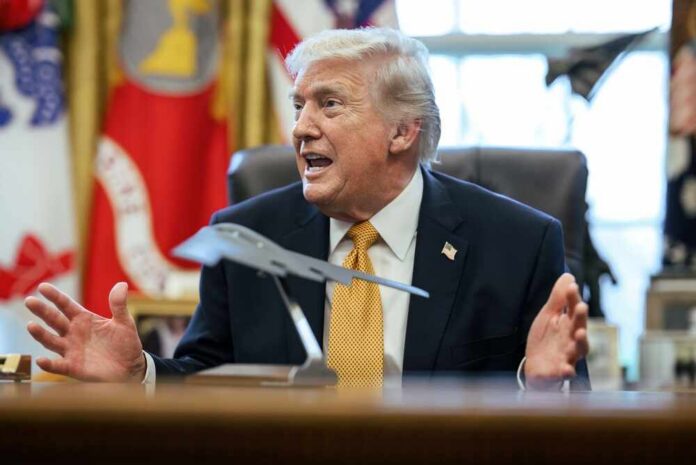
President Donald Trump said in a televised interview with Fox Business that the U.S.-Iran war is “very close to being over,” framing the moment as a chance to lock in an agreement focused on preventing Iran from obtaining a nuclear weapon.
Trump emphasized U.S. leverage, arguing Iran would face a long rebuild if hostilities resumed. The message aims to project control: Washington can pause strikes, but it can also restart them if talks fail.
Trump on Iran war:
I mean, I view it as very close to over. If I pulled up stakes right now, it would take them 20 years to rebuild that country. And we're not finished. We'll see what happens. I think they want to make a deal very badly.
Contributed by @AZ_Intel_. pic.twitter.com/JlWzkQUT0c
— Open Source Intel (@Osint613) April 15, 2026
That dual-track approach—optimism about peace paired with reminders of American power—fits a familiar negotiating style. Supporters see it as pressure designed to protect U.S. interests and allies without committing to an open-ended war.
Critics argue mixed messaging can confuse both adversaries and markets. Based on available reporting, the core fact is straightforward: the White House is advertising diplomacy, but it is not removing the tools of coercion that make diplomacy possible.
Ceasefire and Pakistan Talks Show Momentum, Not a Breakthrough
The current lull stems from a two-week ceasefire in which the U.S. agreed to pause bombing operations. Over the weekend, Vice President JD Vance and other U.S. officials met Iranian representatives in Pakistan.
Public accounts describe the meetings as stalled in the sense that no final breakthrough emerged, while also claiming “a lot of progress.” Vance later summarized the posture succinctly: the “ball is in Iran’s court” ahead of expected Thursday talks.
What is missing in public view is equally important. None of the provided reporting includes detailed terms that would define a durable settlement, verification regime, or enforcement mechanism.
That matters because American voters—especially those wary of decades of foreign-policy “forever problems”—tend to judge deals by what can be verified, not by what is promised. With limited transparency so far, confidence will hinge on whether negotiators can produce clear, enforceable commitments on nuclear constraints.
The Naval Blockade Complicates the “War Is Nearly Over” Narrative
On Monday, Trump instituted a naval blockade of Iranian ports, a step that signals escalation even as the administration sells de-escalation. Reports also suggest enforcement may be imperfect, with some shipping still moving through the Strait of Hormuz.
The contradiction is real: a ceasefire reduces immediate violence, but a blockade raises economic pressure and the risk of miscalculation. If talks succeed, the blockade becomes leverage that helped end a conflict; if talks fail, it becomes a flashpoint.
Markets Are Reacting to Peace Hopes—but Energy Risks Remain
Coverage tied Trump’s upbeat comments to improving market sentiment, including the idea that a resolution could trigger a stronger economic outlook. That reaction is understandable: reduced war risk generally lowers uncertainty and supports investment. Still, the same storyline contains a warning for everyday Americans watching prices.
Any disruption tied to Hormuz shipping or enforcement actions can ripple through energy markets, and energy costs still feed directly into inflation fears that remain politically and economically sensitive.
Iran war 'very close to over,' Trump says — and the stock market 'is going to boom' https://t.co/I8mFxa3qXq
— CNBC Politics (@CNBCPolitics) April 15, 2026
The next test arrives with the expected resumption of talks on Thursday. Trump and Vance are portraying U.S. pressure as a means to secure a nuclear-focused agreement without prolonged conflict, while skeptics point to the ongoing blockade and unresolved details as evidence that “close to over” may be more aspiration than certainty.
For voters who feel the federal government often overpromises and underdelivers, the key metric will be results: a verifiable deal, a stable region, and fewer surprises that hit wallets at home.
Sources:
Trump says Iran war is ‘very close to being over’ as peace talks are expected to resume
Trump says Iran war is ‘very close to being over’ as peace talks are expected to resume
Fox Business Interview Clip (Mornings with Maria)