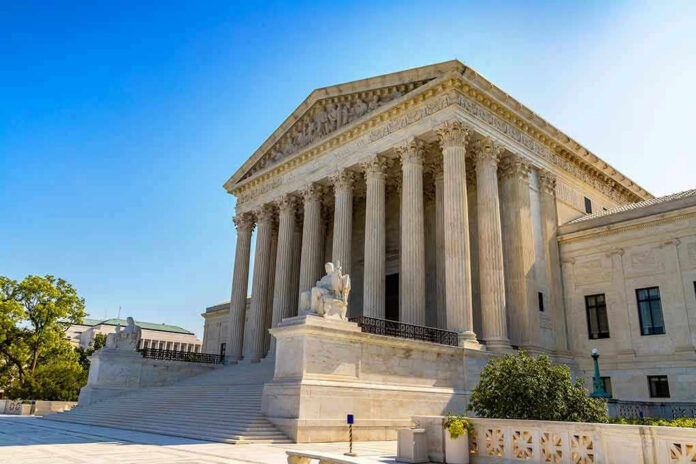
When the Supreme Court told Virginia “no” on its new congressional map, it quietly drew a hard line between voter passion and constitutional procedure.
Story Snapshot
- Virginia voters approved a new congressional map tilted toward Democrats, but courts killed it on process grounds.
- The Virginia Supreme Court said lawmakers violated the state constitution by how they put the amendment on the ballot.[2][3]
- The United States Supreme Court refused to rescue the map, leaving the stricter reading of state law in place.[2]
- The fight shows why conservatives should care more about rules and timing than political spin in redistricting battles.
How Millions Of Votes Vanished In One Paragraph
Virginia’s story starts with a promise that sounded simple: let voters sign off on new congressional districts. More than three million Virginians went to the polls, and a majority said yes to a constitutional amendment that authorized a new map designed to reset the state’s political lines.[1][2]
Supporters framed it as a people-powered response to Republican redistricting wins in places like Texas and Florida, and the map itself would likely have delivered Democrats up to four additional seats in the United States House of Representatives.[2][3]
BREAKING: The Supreme Court rejects Virginia's bid to restore a congressional map favoring Democrats. https://t.co/WrcexMohCv
— The Associated Press (@AP) May 15, 2026
State Democrats treated that referendum result as a moral trump card. The attorney general, legislative leaders, and party allies argued that overturning the amendment would “nullify the votes of millions of Virginians.”[1][2] Their pitch to the courts rested on a familiar argument: once the people speak, judges should get out of the way.
They also claimed the Virginia Supreme Court misread federal election law by treating early voting as part of the “general election” for timing purposes, which they said twisted the law to reach a result-driven outcome.[1]
What The Virginia Supreme Court Actually Said
The Virginia Supreme Court took a far less emotional view. In a 4-3 decision, the court held that the Democratic-controlled General Assembly did not follow the process that the state constitution demands for placing amendments before voters.[2][3]
Lawmakers had moved forward with the amendment after early voting in the general election had already begun, which the court said violated a constitutional timing rule designed to prevent midstream changes that could confuse or mislead voters.[3] The justices concluded that this defect “irreparably undermines the integrity” of the referendum.[3]
Once the court reached that conclusion, everything that followed became legally simple and politically explosive. The amendment that authorized the new map was declared “null and void,” which meant the map itself never had lawful legs to stand on.[3][4]
That outcome did not turn on whether the lines favored Democrats, Republicans, or Martians. It turned on the bedrock idea that rules written in a constitution cannot be waived just because a later vote seems popular or convenient. From a conservative standpoint, that principle is not just technical; it is essential to limited government.
Why The United States Supreme Court Stayed Out
Virginia Democrats then sprinted to Washington. They asked the United States Supreme Court for emergency relief, insisting the state court had overstepped and misapplied federal election law, particularly on the meaning of “Election Day” in a world of expansive early voting.[1][2] They argued that by blocking the voter-approved map and forcing use of older districts, the Virginia court had trampled both voter intent and the legislature’s authority to regulate congressional elections under federal law.[1]
The United States Supreme Court responded with a one-sentence unsigned order: request denied.[2] No justice publicly dissented. That silence spoke volumes. The Court often refuses to referee state-law disputes on its emergency docket, especially when the state’s highest court frames the issue as a question of its own constitution rather than federal rights.[2]
The message aligns with a conservative reading of federalism: states can enforce their own procedural safeguards, even when one party does not like the result. Voter-approved does not mean constitution-proof.
What This Fight Reveals About Power, Process, And Principle
The coverage hammered a simple headline: the map was “drawn to advantage” Democrats and would have given them potentially four extra seats.[2][3][5] That partisan edge made it easy for Republicans to cast the legal fight as a power grab dressed up as reform.
Democrats countered that Republicans had already played the same power game in states such as Texas, Missouri, and Ohio, and that their map merely balanced the scales.[3][5] Both sides wanted advantage; only one side tripped over its own state constitution on the way there.
For readers who lean conservative, the lasting lesson is not that one party gerrymanders and the other does not. Both do, whenever they can. The deeper takeaway is that written rules and timing requirements are the only real brakes on that arms race. When a legislature pushes an amendment after early voting starts, it invites a court to call foul.[3]
When a court insists that the constitutional sequence matters more than short-term political gain, it protects the fabric of self-government, even if that frustrates millions who backed the losing measure at the polls.
Sources:
[1] Web – Supreme Court refuses to restore Virginia redistricting plan …
[2] Web – Supreme Court rejects Virginia Democrats’ bid to revive … – CBS News
[3] YouTube – Virginia Supreme Court strikes down gerrymandered redistricting plan
[4] Web – Supreme Court rejects bid to restore Virginia’s redistricting map …
[5] YouTube – Virginia Supreme Court strikes down Democrats’ redistricting plan