

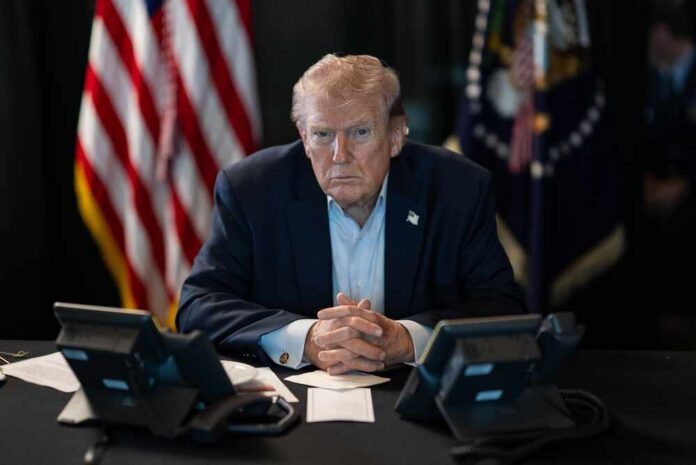
Only 17% of Americans approve of how President Trump is handling the cost of living, according to a new AP-NORC poll.
Quick Take
- A new AP-NORC poll finds 65% of Americans blame Trump’s policies for persistently high prices.
- Just 17% approve of his handling of the cost of living, while his overall economic approval sits at 26%, a new low.
- The survey of 2,140 adults ran September 24-28, 2026, using NORC’s probability-based AmeriSpeak panel.
- Even some Republicans show cooling confidence in Trump’s economic leadership as gas prices climb.
What The New Survey Actually Found
The Associated Press and NORC surveyed 2,140 adults from September 24 through 28, 2026, using NORC’s probability-based AmeriSpeak panel. The result is a clear and uncomfortable picture for the White House.
Sixty-five percent of respondents said they blame Trump’s policies for prices that refuse to come down. Only 17% approve of how he is handling the cost of living, a number AP-NORC describes bluntly as rock bottom.
Economic approval overall also slid. AP-NORC put Trump’s economy approval at 26% in the October survey, down from 30% in an earlier April wave of the same poll series.
AP called the drop a new warning sign for the president heading into the midterms. For a leader who has long leaned on economic strength as a selling point, these numbers mark a real shift in how voters see his first return-term stretch in office.
Most Americans blame Donald Trump for high prices as midterms approach, a new AP-NORC poll finds https://t.co/UyN3mdY2Mu
— Chicago Tribune (@chicagotribune) October 1, 2026
Gas Prices And The Iran War Enter The Picture
AP’s own reporting ties the decline to a specific trigger: rising gas prices tied to the war with Iran. Reporters noted that Trump’s economic approval slumped over the past month as the conflict pushed fuel costs higher, with even some Republicans showing less faith in his leadership on the issue. Roughly half of adults now say they are extremely or very worried about affording gas, up sharply from just 39% back in July.
That detail matters because it gives the poll a concrete, traceable cause rather than a vague mood swing. When a specific policy event, a war overseas, lines up with a specific price spike at the pump, voters notice fast. It’s a reminder that foreign policy and grocery store receipts are never as separate as politicians would like them to be.
Republicans Aren’t Fully Shielded From The Trend
The poll’s partisan breakdown gets interesting for anyone watching midterm math. Earlier AP-NORC waves found Republican approval of Trump’s economic handling splitting closer to even than usual, a notable softening for a base that has historically stuck with him on pocketbook issues. That kind of crack, even a small one, tends to worry campaign strategists more than Democratic disapproval ever would.
Conservative voters didn’t sign up for higher prices at the pump or grocery store, and loyalty has limits when the bill keeps growing. A White House serious about the midterms would treat this slippage among its own coalition as the real flashing warning light, not the predictable disapproval from voters who were never going to approve anyway.
Most Americans blame Trump for high prices as midterms approach, a new AP-NORC poll finds https://t.co/HUNaCUhP61
— VeronikM-RESISTANCE-#TAEM #TousAvecEmmanuelMacron (@VeronikMouhat) October 1, 2026
Why This Poll Carries Weight Heading Into Midterms
Economic approval numbers rarely move in isolation, and this one fits a pattern seen across multiple pollsters in 2026, not just AP-NORC. When inflation and gas prices stay elevated for long stretches, voters tend to personalize the blame onto whoever occupies the Oval Office, regardless of how mixed the underlying causes actually are. That dynamic has shown up before in American politics and rarely reverses quickly once it sets in.
What happens next depends heavily on whether gas prices ease and whether the Iran conflict resolves before voters head to the polls. Until then, the numbers stand on their own: a 17% approval score on cost of living and 65% of the country pointing the finger directly at the president’s policies. Those are not abstract numbers. They are the kind that shape campaign ads and change seats.
Sources:
usnews.com, ap.org, apnews.com, ground.news