

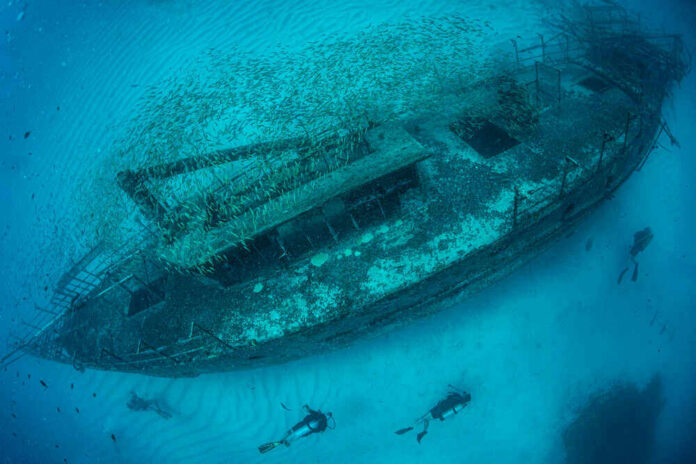
A pile of broken clay jars scattered on the Mediterranean floor just became the oldest shipwreck ever documented, and the ship that carried them is long gone.
Story Snapshot
- Divers off Turkey’s Kekova Island found more than 30 ceramic storage jars and three stone anchors from a sunken Early Bronze Age cargo ship.
- Archaeologists date the wreck to between 4,400 and 4,700 years ago, roughly the era the Great Pyramid was built.
- Professor Hakan Öniz of Akdeniz University led the expedition and called the site a “time capsule at the bottom of the sea.”
- Turkey’s Culture and Tourism Ministry publicly confirmed the find, noting that the wooden hull had fully decayed over the millennia.
A Cargo Field Where a Ship Once Sailed
The wreck sits near Kekova Island, a stretch of coastline known in antiquity as Dolichiste. Divers mapped a dense scatter of amphorae, the clay jars ancient traders used to haul liquids and goods across the sea. Three stone anchors lay nearby, the kind of heavy ballast a Bronze Age captain would have dropped to hold a ship steady against the current.
Together, the jars and anchors form more than a random debris pile. Archaeologists treat that combination, dozens of matching storage vessels paired with ship’s tackle, as the signature of a single vessel that went down with its cargo intact. The ministry’s own account described the find in those same terms, underscoring it as a wreck event rather than scattered pottery washed into one spot.
Dating a Ship With No Wood Left to Test
None of the ship’s timber survived underwater after nearly five thousand years, so researchers could not radiocarbon date the hull itself. Instead, they compared the amphorae’s shape and decoration to pottery from other known Early Bronze Age sites. That comparison placed the wreck between 4,400 and 4,700 years old, according to The National.
Öniz, who leads the Mediterranean Archaeology Association expedition, estimated the sinking fell within that same window near Kekova Island. The method relies on well-established pottery typology, a standard tool in Mediterranean archaeology when wood is gone. Comparable wrecks studied elsewhere have used the same ceramic-dating approach because organic hulls rarely survive centuries of saltwater exposure.
Why Turkey Is Calling It the World’s Oldest
Minister Mehmet Nuri Ersoy announced the discovery and tied its age to the amphorae pulled from the seabed near Kekova. CNN reported the ministry’s figure matched the 4,400 to 4,700-year range given by the research team. That timeline would place the wreck roughly a century or two before other well-known ancient wrecks found in Greek waters.
Researchers describe the contents as likely olive oil or wine, the two staples most often shipped in amphorae of that era across the eastern Mediterranean. The jars themselves point to an active trade network moving goods by sea nearly 2,700 years before Christ. That alone reshapes how far back organized maritime commerce in the region can be traced.
What the Find Means for Ancient Trade History
The wreck was first spotted during an Akdeniz University survey in 2024, well before this week’s public announcement. That timeline shows the discovery went through a period of underwater documentation before being unveiled, rather than being rushed to press. Öniz’s “time capsule” description reflects how undisturbed the cargo field appeared when his team returned.
Archaeologists uncover what’s left of ancient shipwreck dating back 4,400 years near Turkish island https://t.co/hzZ536emKq pic.twitter.com/CWgkJusrcf
— bulletinindy (@bulletinindy) October 14, 2026
Bronze Age seafarers moved stone, pottery, and food across open water long before anyone assumes they could. This wreck adds hard physical evidence to that picture, sitting on the seabed as proof that ships were hauling cargo across the Mediterranean while Egypt’s pyramids were still under construction. The jars and anchors now stand as the oldest known record of that trade in motion.
Sources:
cbsnews.com, bbc.com, aa.com.tr, cnn.com, thenationalnews.com