

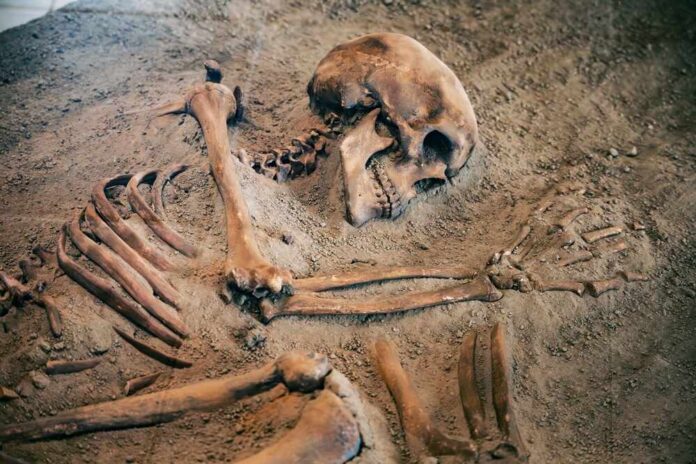
Ninety years after she was beaten and buried under a Toronto garage floor, Mary McLeod Moffat finally has her name back.
Story Snapshot
- Demolition crews in 1995 found a hidden skeleton under a Danforth Avenue auto shop.
- Police now say the victim was Scottish immigrant and young mother Mary McLeod Moffat.
- New DNA and genetic genealogy tools cracked what detectives once thought was impossible.
- Investigators believe her husband killed her in 1936, but he died decades ago.
A body under the garage floor on the Danforth
On a spring day in 1995, demolition workers tore into the concrete floor of an old automotive garage at 1515 Danforth Avenue, near Coxwell Avenue in Toronto. Under the slab, buried in soil, they found the skeleton of a woman who clearly was not meant to be found.
Police later said she had been intentionally buried after suffering at least six blunt-force blows to the head from a hammer-like weapon, and they ruled her death a homicide. For years, she was simply a Jane Doe under the garage.
Woman murdered in 1936 and buried underneath building is finally identified: "One of Toronto's oldest mysteries" https://t.co/G1fbB2nQXG
— CBS Mornings (@CBSMornings) July 28, 2026
Detectives worked the case, but the trail went cold fast. No one matched missing person reports. Dental records did not help. The murder weapon was never recovered.
She joined the quiet list of unsolved Canadian murders that linger in files and family memories. The site became just another city corner people walked past on their way to coffee, never knowing a woman had been hidden beneath their feet for decades.
How science reached back to 1936
What changed was technology and patience. In 2022, Toronto Police Service selected the case for a new push using investigative genetic genealogy, a method that looks at long stretches of DNA and compares them against people who have shared their DNA with consumer or public databases.
It took two years and multiple lab attempts before experts finally pulled a strong DNA profile from the old bones, something detectives say was a “robust” sample they could trust.
That profile did not just say “female, middle-aged.” It carried clues about ancestry and family lines. Genetic genealogists and police, working with a private lab that promotes these cases as success stories, built family trees and checked them against historical records.
They then tracked down living relatives, interviewed family members, and matched reference DNA samples to the unknown woman. Step by step, the Jane Doe under the garage became Mary McLeod Moffat.
The life that was stolen
Police say Mary’s story began far from Toronto. She was born in Scotland in 1905 and immigrated to Canada with her family in 1913, part of the wave of hopeful newcomers looking for work and safety in the New World. Records show she married in 1929 and had a son in 1930. She lived in Toronto, where her “last footprint of life” appears in the mid-1930s.
Then the footprints stop. Toronto police now believe she was likely murdered around April 1936. Their investigation, blending old documents and modern science, points toward her husband as the suspect. They say a confrontation led to her death and that he buried her body at the garage site.
Justice when the suspect is already dead
There is a hard catch. The man investigators suspect as the killer died in 1985. No court will ever try him for Mary’s murder. There will be no cross-examination, no jury, no formal verdict. That gap matters.
Identification is now solid enough for police to speak with confidence, backed by DNA and records. But cause of death and guilt are still built from reconstruction, not fresh physical evidence and live witnesses.
That does not mean the suspicion is weak. It means the case lives in a category more common in today’s cold-case world: we can finally name the victim and likely scenario, but the legal door to punishment is closed.
For many families, including Mary’s descendants, truth still has value on its own. They now know she did not simply vanish or abandon her child. She was killed, hidden, and forgotten by systems that were supposed to protect her.
The rise of genetic genealogy and what it can and cannot do
Mary’s case is one of two Toronto identifications police now call among their most significant successes using investigative genetic genealogy. Across Canada and the United States, similar methods have given names back to “Woman in the Well” in Saskatoon and other long-lost victims, using relatives’ DNA, archive records, and careful detective work.
There is a tradeoff. Corporate labs and police agencies lead the work and shape the story. The public rarely sees the full lab reports, chain-of-custody records, or the private family charts behind the breakthroughs.
In Mary’s case, the evidence for her identity is far firmer than the evidence for exact motive and guilt. That is the line worth keeping clear, even while we welcome the fact that a woman buried in secret has finally been recognized.
Sources:
cbsnews.com, globalnews.ca, thespec.com, youtube.com, facebook.com, cbc.ca