
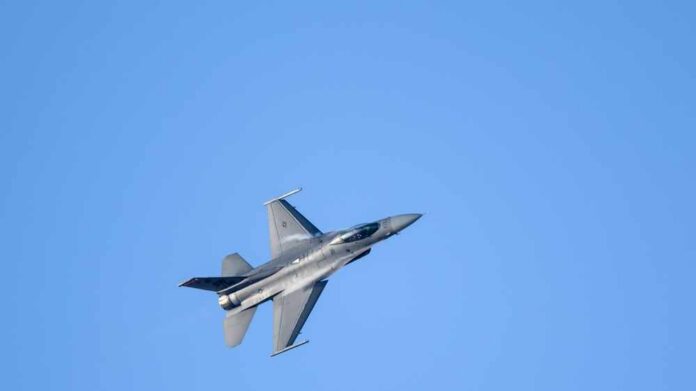
Two F-16 fighter jets rushed to Cincinnati’s skies and pushed a stray plane out of restricted airspace while President Trump spoke at a rally minutes away.
Story Snapshot
- NORAD said F-16s intercepted a general-aviation plane over Cincinnati around 3 p.m. local.
- The plane violated a temporary flight restriction tied to the President’s nearby rally.
- The jets escorted the aircraft out without force; the area returned to normal quickly.
- Similar incursions during presidential events are common and usually end with safe escorts.
F-16s Move Fast After Airspace Violation Over Cincinnati
The North American Aerospace Defense Command said its F-16 fighter jets intercepted a general-aviation aircraft that entered restricted airspace over Cincinnati on the afternoon of October 17, 2026. The intercept happened as President Trump delivered remarks at a rally across the river in northern Kentucky. NORAD placed the intercept at about 3:00 p.m. and said the aircraft was safely escorted out of the restricted zone. No weapons were fired, and the situation ended without injury or damage.
Temporary flight restrictions are standard when the President travels. The Federal Aviation Administration sets an inner no-fly core and a larger guarded ring. Air-defense controllers then watch radar for any “track of interest.” When a plane ignores warnings or stumbles inside the ring, NORAD launches fighters. Pilots see a jet on their wing, receive radio calls on guard frequency, and get clear visual signals. The goal is compliance and safety, not a dramatic chase or a shootdown.
What Likely Triggered The Scramble
The most common cause is a small aircraft whose pilot missed the notice or misread the boundary. General-aviation flights often run on tight margins and basic avionics. If the pilot did not check notices to air missions or update their route, a drift into the ring can happen fast. NORAD’s doctrine stresses graduated steps: radios, flares if needed, and a wing-rock escort to guide the plane out. Saturday’s intercept followed that playbook and resolved cleanly.
Military and civil agencies coordinate these moves in real time. Air traffic controllers alert NORAD when a target turns toward the restricted zone. The fighters launch from alert status, usually within minutes. The goal is time. The earlier the intercept, the gentler the fix. Saturday’s timeline fits this model. The quick response and smooth escort suggest the pilot complied once cued and that cockpit communications worked as designed, from guard frequency to visual signals.
A Recurring Pattern Around Presidential Travel
The Cincinnati intercept is not rare. NORAD has reported a string of similar events in recent years. Fighters escorted aircraft out of restricted airspace over Palm Beach in March 2025, including days with multiple violators. They did the same over Bedminster and East Rutherford in July 2026 after more than ten aircraft drifted toward the ring, three of which needed a fighter escort. Geneva, Ohio saw another safe escort in August 2026. Each case ended without force.
Military fighter jets intercepted a plane flying through restricted airspace over Cincinnati, Ohio, while President Trump was speaking at a nearby rally in Kentucky. https://t.co/FOKFoy5mdj
— CBS News (@CBSNews) October 19, 2026
These records show a pattern, not a mystery. Temporary flight restrictions reduce risk around high-profile events. Most violators are careless, not criminal. That does not lessen the stakes. The system must treat every unknown as a possible threat until proven otherwise. From a common-sense view, this is government doing its first job: protect life, protect the President, and keep the public square open. Order and deterrence depend on swift enforcement that is fair and firm.
Why This Matters And What Comes Next
Saturday’s intercept did two things at once. It kept the rally safe and it reminded general-aviation pilots that the skies have rules. The Federal Aviation Administration can take action after a violation. Pilots may face a suspension, training, or a civil penalty. In many cases, federal officers meet the pilot on the ramp. That follow-up builds a culture of care, which lowers the odds of repeat mistakes and cuts the need for more intercepts.
Airspace security works best when both sides do their part. NORAD maintains alert fighters and tight procedures. Pilots plan better, brief notices to air missions, and keep a portable receiver or app up to date. The formula is simple: clear rules, strong enforcement, and personal responsibility. That is the blend that keeps freedom of movement alive without letting confusion become risk. Cincinnati showed the system doing exactly what it was built to do.
Sources:
hoodline.com, x.com, cbsnews.com