

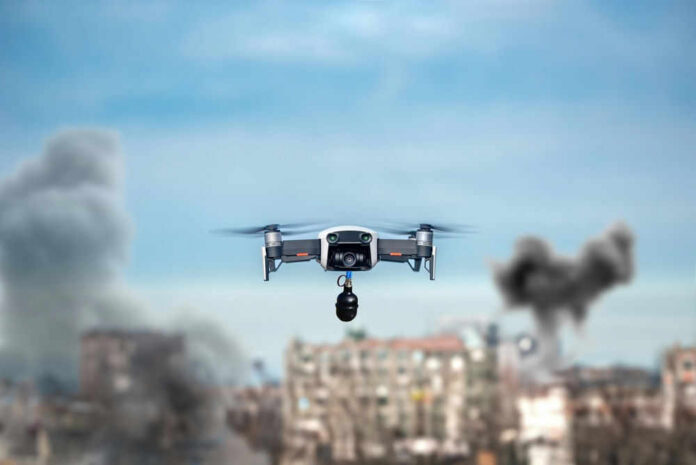
Mexican cartel operatives allegedly used Ukraine’s war to learn first-person-view attack drone tactics, and officials took it seriously.
Story Snapshot
- Mexico’s intelligence service warned Ukraine about cartel-linked volunteers seeking drone training.
- Ukrainian services opened a probe into Spanish-speaking volunteers tied to the International Legion.
- Named suspects and forged documents appeared in reporting on targeted drone courses.
- Cartel drone attacks in Mexico have surged, matching battlefield-style tactics.
Intelligence Warning Sparks Ukrainian Investigation
Mexico’s National Intelligence Center sent a confidential warning to Ukraine’s security service in early summer 2025. The memo said some Mexican volunteers in Ukraine were seeking first-person-view drone training to take back to cartels.
Ukraine’s security service and defense intelligence opened a joint probe into Spanish-speaking volunteers linked to units around the International Legion. This move signaled a clear concern: battlefield drone skills were crossing borders faster than traditional policing could react.
Defense-focused outlets detailed the areas of interest. Reports described scrutiny of volunteers tied to specialized training groups and drone schools. In this reporting, officials outlined a vetting model with layered checks at borders and through international databases.
They also admitted that determined operatives can sometimes get through. The stakes were high because battlefield-tuned first-person-view tactics are simple to teach, cheap to field, and deadly in the wrong hands.
Named Trainees, Forged Papers, and Targeted Drone Courses
Reporting named specific suspects. One, called “Aguila Siete,” was described as a former Mexican special operations member who entered Ukraine on a false Salvadoran passport and trained at a private facility in Lviv.
The same account said three former Colombian guerrillas used forged Panamanian documents to finish drone training. These details fit a known pattern: false identities, short training cycles, and rapid exfiltration. None of that demands large budgets, only discipline and access.
The rapidly accelerating use of drones among Latin American drug cartels will significantly complicate the Trump administration’s campaign to halt the flow of illicit narcotics into the U.S., according to some officials. https://t.co/WM81slskxI
— The Washington Post (@washingtonpost) September 22, 2026
Ukrainian and European training hubs became fast classrooms. Instructors taught build methods, radio links, fusing, and attack profiles suited for small explosive payloads. Students learned to hit vehicles, rooms, and defensive positions. They practiced flying low, fast, and accurately.
They learned to evade jamming and to swap frequencies. Short, repeatable drills made the skills sticky. When such skills jump from a front line to a street fight, police lose standoff and time. That is why the warning drew quick action.
Mexico’s Cartels Already Run a Drone Playbook
Mexican cartels had moved past hobby drones before this alert. They used aircraft for scouting, intimidation, and attacks that break police lines and terrorize towns. Spanish reporting described how cartels stacked innovations, from improvised munitions to fleet-style swarms, to gain shock and control.
That record gives weight to fears that battle-hardened first-person-view methods would speed the next leap. It also explains why United States officials now link this trend to rising border and homeland risk.
Latin American drug cartels are recruiting veterans of the Russia-Ukraine war to expand their drone capabilities, raising concerns about whether U.S. and Mexican authorities are prepared to counter the threat, according to a new report.
— Bob Hafer 🍊 (@rehafer) September 22, 2026
American conservative values stress law, borders, and order. On that score, the facts point to a simple test: stop foreign conflict skills from arming crime at home. That means tighter vetting for volunteers in war zones, stronger passport and biometric checks, and fast data sharing among allies.
It also means treating first-person-view drone threats like the car bomb problem a generation ago: train cops, harden targets, map supply chains, and punish enablers with real teeth.
What Comes Next: Policy, Policing, and Proof of Life
Ukrainian services have probes in motion, according to named outlets, and Mexico’s warning shows cross-border cooperation can work. Practical steps look clear. Ukraine can keep its layered screening and add spot audits at training sites. Mexico can track returnees who traveled through known hubs.
The United States can surge counter-drone tools to border units and major police departments. Shared watchlists, faster extraditions, and targeted action against parts suppliers can blunt the learning loop that cartels exploit.
One caveat remains: reporting stops short of public court files tying a named trainee to a specific attack. That gap does not change the mission. Police and intelligence work on evolving threats before the courtroom is ready. Cartels move on speed, surprise, and fear.
Governments must move on facts at hand and patterns already in play. When low-cost drones turn every alley into a potential strike lane, urgency beats comfort. The warning was timely. The response now decides the curve.
Sources:
militarnyi.com, newsmax.com, twz.com, theins.press, english.elpais.com