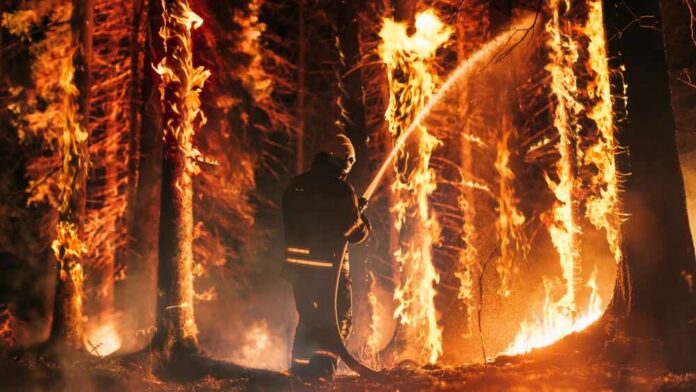
One split-second burnover on a Colorado hillside did what years of danger never did—it wiped out almost an entire elite wildfire crew and kept claiming lives weeks later.
Story Snapshot
- A fourth firefighter, 43-year-old Nathan Matthews of Nebraska, died from burn injuries after the June 27 Colorado wildfire burnover.
- Matthews and his Rifle Helitack crew were overrun by the Knowles Fire, part of the larger Snyder Fire, near the Colorado–Utah border.
- Three crew members died at the scene; Matthews fought for his life for nearly a month before succumbing to his injuries.
- The case exposes hard questions about wildfire risk, strategy, and how America treats the people it sends into the flames.
The burnover that turned a routine attack into a fatal trap
Fire crews flew into western Colorado on June 27 expecting a hard, hot day, not a mass-casualty event. The Rifle Helitack crew was doing what they were trained to do: drop in by helicopter and hit the Knowles Fire fast before it exploded. A burnover changed everything.
Flames moved so quickly they cut off escape routes and engulfed the crew on the slope near the Colorado–Utah line, turning that hillside into a lethal choke point.
JUST IN: A fourth wildland firefighter died Friday from injuries battling the Knowles Fire near the Utah-Colorado border, according to the United States Department of the Interior. https://t.co/M3zYguemwD pic.twitter.com/tSIpXes3Ri
— ABC4 News (@abc4utah) July 25, 2026
Burnovers are every wildland firefighter’s nightmare, because once the fire wraps around you, there is almost no good choice left. Three members of the helitack team—Emily Barker, Nick Hutcherson, and Sydney Watson—died there on the line.
Matthews survived the initial blast of heat but suffered severe burns. He was evacuated and moved into long-term care, beginning a quiet, brutal second fight that few outside his circle could see.
Who Nathan Matthews was before the headlines
News reports often reduce people to name, age, hometown, and cause of death. Matthews deserved better than that. Federal officials identified him as a 43-year-old firefighter from Lincoln, Nebraska, assigned to the United States Forest Service Rifle Helitack crew.
People do not land on a helitack crew by accident. That role demands top fitness, experience, and a willingness to step off a helicopter into chaos with little backup and even less comfort.
He was part of what many call the “wildland fire family,” a loose brotherhood and sisterhood that crosses states and agencies. When something goes wrong, the shock ripples across the country, from Western slope ranch towns to Midwestern suburbs like Lincoln.
Matthews’ death did not just hit one station; it shook an entire network of men and women who sleep with their boots by the door every summer, waiting for the next call.
From first accident reports to a fourth line-of-duty death
The first wave of coverage focused on the three firefighters killed in the burnover. To the public, it looked like a single tragic incident with a fixed death toll.
Inside burn units and federal offices, people knew the story was not over. Matthews remained in critical care for weeks, treated for extensive burns from the June 27 incident while his colleagues were already being mourned.
On a Friday nearly a month later, the United States Department of the Interior announced that Matthews had died from his injuries. Reports noted that he was the fourth firefighter lost to that same fire, part of the Snyder Fire complex near the Colorado–Utah border.
Another firefighter in Colorado had already died in a separate helicopter crash that season, pushing the year’s toll even higher and underscoring how risky this work has become.
What this says about risk, policy, and basic fairness
Every summer, leaders praise first responders as heroes, then send them into ever bigger fires with politics slowing real fixes. Growth in fuel loads, slow forest treatment, and pressure to “keep every community safe” combine into a deadly mix for crews on the ground.
The Knowles Fire burnover fits a troubling pattern: an aggressive initial attack on a fast-moving fire that leaves line firefighters holding the highest risk while decision-makers stay miles away.
We are heartbroken by the loss of wildland firefighter Nathan Matthews, who passed away from injuries sustained while responding to the Knowles Fire in Colorado.
Today, we honor his service and remember Emily Barker, Nick Hutcherson, and Sydney Watson, who were also lost during… pic.twitter.com/pRiSjhVfPT
— Bridger Aerospace (@BridgerAero) July 26, 2026
Americans value pride in duty, service, and the idea that government owes its people honesty and basic competence. By that measure, the system often fails firefighters like Matthews.
They accept extreme danger. In return, they should get clear risk assessments, gear that matches the threat, and a strategy that does not treat them as disposable shields for bad land policy. When four people from one crew die on one fire, that is not just bad luck; it is a warning light.
Why their sacrifice should change how we fight fire
Officials have launched a serious accident investigation into the burnover, which will look at weather, tactics, communication, and command decisions. Too many times, those reports end up as technical documents few citizens read while the same structural problems linger.
If four line-of-duty deaths in one incident do not move the needle, what will? A country that asks ordinary men and women to step into walls of flame owes them more than press releases and lowered flags.
This case says you fix known dangers before they kill more people. That means better thinning and fuel breaks around at-risk communities, honest talk about which homes cannot be defended in extreme conditions, and more weight given to firefighter safety when fire behavior crosses certain lines.
Matthews and his crew did their part on that Colorado hillside. Now the rest of the country has to decide if it will do its part in return.
Sources:
cbsnews.com, fox13seattle.com, usatoday.com, facebook.com, ksl.com