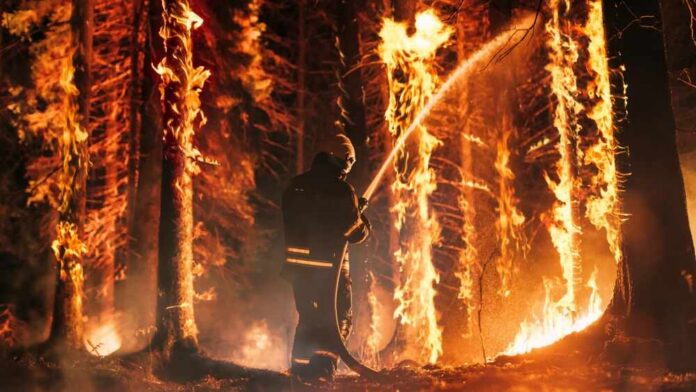
More than 200,000 people ran from fires in France and Spain, and some had to escape by boat as Europe’s comfort zone went up in smoke.
Story Snapshot
- Wildfires near Bordeaux and Madrid forced over 200,000 people to evacuate in days.
- Some residents and tourists fled France’s Atlantic coast by boat as flames closed roads.
- Spain declared a national emergency, putting central government in direct control of firefighting.
- France drafted in troops and foreign aircraft to stop the fire from reaching Bordeaux.
When a Summer Vacation Turns Into a Mass Evacuation
People woke up on what should have been a normal summer Friday and found the sky over France’s Atlantic coast and central Spain turning the wrong color. Smoke rolled in, ash fell on cars, and local police started knocking on doors with one message: you have to leave now.
By nightfall, more than 200,000 people were on the move, many with only what they could stuff into a trunk or backpack, as fires burned out of control on both sides of the Pyrenees.
Wildfires in Spain are completely out of control. More than 300.000 people across Spain and France have been evacuated.
Heroic firefighters are fighting day and night to prevent it from spreading further.
Thank you for your immense service. pic.twitter.com/EmH4t5JHq8
— France Safety Travel (@francesafetytra) July 26, 2026
In southwestern France, the Gironde and Landes regions were hit hardest. Authorities reported around 141,000 evacuees from those two departments alone, a mix of year-round residents and tourists packed into campgrounds and rental homes along the Atlantic coast.
The Cap Ferret peninsula, usually a postcard of lazy beaches and seafood, emptied as flames jumped the pines. Roads choked, some were cut off entirely, and people who could not drive out in time took the only route left: the water.
Boats, Backroads, and a Race Against a Moving Wall of Fire
Cap Ferret’s year-round population is only about 8,000, but in summer it swells to many times that as visitors arrive for sand and oysters. When fire pushed toward the peninsula, local officials ordered a full evacuation. Some residents drove through thick smoke, past lines of emergency vehicles.
Others boarded boats as the shore glowed behind them, heading across the bay to Arcachon, where makeshift camps sprang up in halls and parking lots for those who fled with almost nothing. It was chaos, but it was also organized enough to avoid mass casualties.
Just inland, the bigger fear was Bordeaux. Fires that had started closer to the coast shifted direction and began moving toward the city region, pushed by wind and fueled by dry forest. Officials reported the flames within several kilometers of key entry points, close enough that the Bordeaux mayor spoke openly about the risk of fire reaching city suburbs.
French leaders promised to “reorganize” the fight, shifting to strong ground defenses to block the advance toward the metropolitan area. For a country that prides itself on order, it was a hard admission: nature had seized the initiative.
Spain Puts Central Government in Command as Fires Close in on Madrid
Across the border, Spain faced its own nightmare. Multiple fires near Madrid and in the province of Ávila began to merge, creating larger fronts that outpaced regional response plans.
The Spanish Interior Minister Fernando Grande-Marlaska declared a national emergency for wildfires, meaning the national interior ministry took direct charge of police, emergency, and security forces involved in the fight. That is a serious step in any democracy: it signals that normal local systems cannot handle the scale of the crisis.
Evacuations in Spain reached around 60,000 people in affected areas west of Madrid and around Ávila, including about 29,000 forced from homes near the capital and over 20,000 confined indoors because roads were blocked and smoke made movement unsafe. Helicopters and water-dumping aircraft flew repeated runs as a thousand soldiers joined firefighters on the ground.
Prime Minister Pedro Sánchez talked publicly about providing shelter and support for both evacuees and those stuck at home, trying to show that the state was not just ordering people around but also standing behind them. This is where accountability matters: if government is going to claim emergency powers, it should also handle the human cost.
Troops, Foreign Aircraft, and the Limits of Comfort Politics
France did not pretend this was business as usual. Interior Minister Laurent Nuñez put the national evacuation count around 167,000 people as some thirty fires burned at once. President Emmanuel Macron ordered the armed forces into the firefight and requested activation of the European Union Civil Protection Mechanism to bring in foreign assets.
That mechanism sent Croatian Canadair water-bombing planes, Portuguese Air Tractor aircraft, and heavy Black Hawk helicopters from the Czech Republic and Slovakia to help knock down the flames. It was a real stress test of cross-border promises.
🚨 BREAKING: 360,000+ evacuated as wildfires rage across France and Spain. 42,000 ha burned in Gironde alone – worst since WWII. Flames advancing toward Bordeaux wine region. Spain declares national emergency. $WEATHER $EURO #Wildfires #ClimateEmergency
— GlobalFlash (@GlobalFlash_Cam) July 27, 2026
Europe likes to talk about climate policy and long-term emissions targets. This crisis forced leaders to talk about bulldozers, field hospitals, and evacuation buses instead. People slept in cars, crowded shelters, or on cots lined up in exhibition halls as firefighters, many already injured or exhausted, tried to hold lines in intense heat.
Counting the Cost and Asking Hard Questions
Numbers varied as the hours passed. Different outlets and authorities cited totals from about 200,000 up past 250,000 evacuations, depending on the timing and which fires they counted. That swing does not mean the danger was hyped; it shows how messy real-time reporting is when multiple fire fronts move at once and local agencies update their tallies late into the night.
What remains consistent is the core reality: hundreds of thousands were displaced, dozens of firefighters were hurt, and major European cities felt a direct wildfire threat.
For readers used to stable suburbs and reliable services, this episode should ring an alarm bell. Wildfire is no longer a far-off problem in the American West or rural Australia. It is now a direct risk to dense European regions with busy airports, wine economies, and long histories of settled life. That does not mean panic.
It does mean pushing leaders to focus first on practical resilience—clearing fuel, enforcing smart building rules, backing responsible forestry—before chasing applause with big climate slogans. A fire does not care about press releases; it only respects hard work done in advance.
Sources:
youtube.com, nbcnews.com, wsj.com, whmi.com, abcnews.com, straitstimes.com, bbc.com