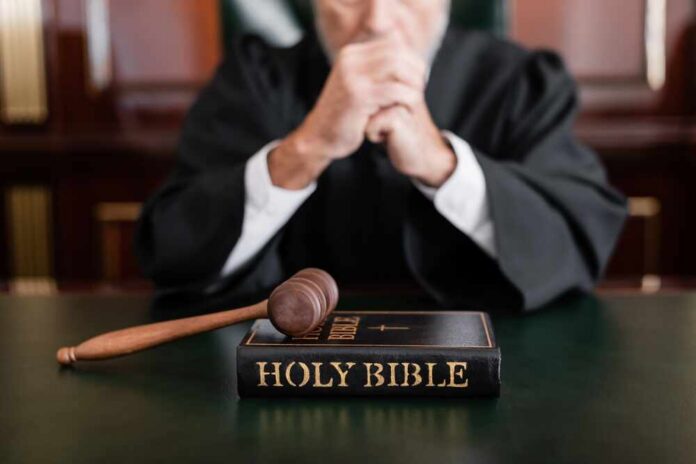
A federal appeals court just handed Texas the green light to post religious commandments in every public school classroom across America’s second-largest state, upending decades of church-state separation jurisprudence and potentially reshaping what millions of children see on their classroom walls each day.
Story Snapshot
- Fifth Circuit Court of Appeals upheld Texas Senate Bill 10 in a 12-6 vote, requiring 16×20 inch Ten Commandments displays in every public classroom
- Court ruled the mandate constitutes historical acknowledgment rather than religious coercion, reversing lower court injunctions that blocked enforcement
- Decision follows similar February ruling allowing Louisiana displays, creating momentum for nationwide expansion of religious symbols in public education
- Case likely headed to Supreme Court, where post-2022 conservative majority may cement new church-state boundaries
- Approximately two dozen Texas districts already posted displays through private donations while fighting legal challenges
The Ruling That Changes Everything
The Fifth Circuit’s April decision represents more than courtroom procedure. The ruling reversed district court injunctions and declared Texas Senate Bill 10 fully constitutional, clearing the path for mandatory religious displays in the nation’s largest school system.
The court’s majority dismissed First Amendment challenges with striking brevity, declaring the law “puts a poster on a classroom wall” without punishment, taxation, or required religious observance.
That framing sidesteps the core question opponents raise: whether government-mandated religious texts in compulsory education settings inherently carry coercive weight, regardless of explicit penalties.
What Texas Law Actually Requires
Senate Bill 10 leaves nothing to interpretation. Every public elementary and secondary classroom must display the Ten Commandments on durable posters or framed copies measuring at least 16 inches wide by 20 inches tall, positioned conspicuously where students cannot avoid seeing them daily.
The Texas Legislature enacted the measure in June 2025, with enforcement beginning September 1 of that year. The specificity matters because vague accommodation gets struck down, while detailed mandates like those crafted in Texas survive scrutiny by appearing neutral and historically grounded rather than devotional.
The Louisiana Connection and Broader Strategy
Texas didn’t pioneer this approach alone. The Fifth Circuit cleared Louisiana’s similar mandate on February 20, 2026, just weeks before Greenlight Texas.
Both cases moved through coordinated legal challenges, with oral arguments heard together in January. This parallel track reveals a deliberate strategy: conservative states testing identical policies across jurisdictions to create appellate precedent favoring religious displays.
The coordination worked, producing consistent rulings that now embolden other Republican-controlled legislatures. Roughly two dozen Texas districts jumped ahead, posting displays through private funding even while injunctions theoretically blocked the law, demonstrating grassroots enthusiasm that legal obstacles couldn’t contain.
Texas's law requiring public schools to have a copy of the Ten Commandments posted in classrooms does not violate the Constitution, a federal appeals court ruled, plowing new ground in religious law. https://t.co/WSsT6NAZJj
— The Washington Times (@WashTimes) April 22, 2026
The Constitutional Tightrope
The court’s reasoning hinges on distinguishing acknowledgment from indoctrination. Judges emphasized that no teacher delivers religious instruction alongside these posters, no student faces punishment for disagreement, and no taxpayer funds get earmarked for worship activities.
The displays exist merely as historical artifacts that recognize Judeo-Christian influence on American legal foundations. That logic conflicts sharply with 1980’s Stone v. Graham, where the Supreme Court struck down Kentucky’s classroom Ten Commandments requirement as plainly religious.
What changed? The current Supreme Court’s 2022 rulings permitting coach-led prayer and expanding religious expression in public forums signaled openness to reconsidering old barriers, emboldening lower courts to reinterpret Establishment Clause limits.
Who Wins and Who Loses
The immediate winners include Texas legislators who campaigned on restoring religious heritage in schools, conservative legal groups seeking expanded religious accommodations, and families who view moral instruction as inseparable from education.
The losers remain less visible but real: religious minority students whose sacred texts get excluded, non-religious families objecting to state-endorsed theology, and educators navigating questions about why one religious tradition merits wall space while others don’t.
The Fifth Circuit acknowledged that the plaintiffs raised sincere religious objections but ruled that those concerns were insufficient to block historical displays, effectively deciding that some discomfort doesn’t constitute a constitutional violation.
Federal appeals court upholds Texas law requiring Ten Commandments in classrooms https://t.co/mspqsYM1sx
— CBS News (@CBSNews) April 22, 2026
This case is almost certain to reach the Supreme Court, where six conservative justices hold the power to either affirm or narrow the ruling. A broad affirmation could trigger nationwide adoption in red states, transforming public education’s religious neutrality into active historical acknowledgment of specific faith traditions.
The implications extend beyond posters: if the government can mandate the display of religious texts without violating the First Amendment, what other religious expressions become permissible in compulsory settings?
The court framed this as mere acknowledgment, but precedent built on such reasoning reshapes fundamental assumptions about where religious expression ends and government endorsement begins in American public life.
Sources:
Federal appeals court upholds Texas law requiring Ten Commandments in classrooms – CBS News
Texas classrooms can display Ten Commandments, appeals court rules – The Independent
Federal court upholds Texas law requiring Ten Commandments in public classrooms – Fox News