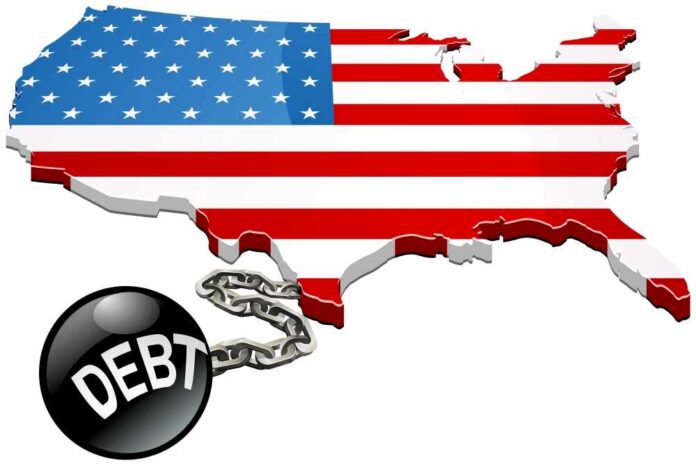
America’s national debt has exploded to $38.56 trillion, now barreling toward levels that will eclipse even the desperate wartime borrowing of World War II—but this time, we’re not funding the defeat of tyranny, just decades of reckless government spending and broken promises.
Story Snapshot
- U.S. gross national debt hit $38.56 trillion as of February 2026, up $2.35 trillion year-over-year, growing at $6.43 billion daily
- Debt-to-GDP ratio projected to hit 107% by 2029, surpassing the post-WWII peak of 106% reached in 1946
- Interest payments consumed $1 trillion last year—18% of federal revenue—with rates climbing to 3.348% on marketable debt
- Every American now shoulders $113,354 in national debt, with experts warning fiscal crisis is “almost inevitable” without major spending reforms
Unprecedented Peacetime Debt Crisis Looms
The Congressional Budget Office projects federal debt will reach 107% of GDP by 2029, officially surpassing the World War II-era peak of 106% achieved in 1946. Unlike that historic borrowing, which financed the defeat of fascism and was rapidly paid down through postwar growth, today’s debt stems from chronic peacetime overspending on entitlements, tax policy shifts, and crisis responses.
The debt stood at $38.56 trillion as of February 4, 2026, having increased by $2.35 trillion over the previous year alone. This growth rate translates to $6.43 billion added daily, with projections indicating the debt will cross $39 trillion by April 12, 2026.
U.S. debt hit $37.6T in FY 2025, 121% of GDP, and above the WWII peak. Debt growth slowed last year, but without Congress restraining spending, fiscal crises will keep coming. | Craig Eyermann pic.twitter.com/ROo48E59vm
— Independent Institute (@IndependentInst) February 4, 2026
Interest Costs Devour Federal Budget
Net interest payments on the national debt reached approximately $1 trillion last year, consuming roughly 18% of all federal revenue and projected to account for 13.85% of total federal outlays in fiscal year 2026. This far exceeds the post-WWII high of 3.2% of GDP.
The average interest rate on marketable federal debt has climbed to 3.348%, up dramatically from 1.541% just five years ago, reflecting the Federal Reserve’s inflation-fighting rate hikes.
The Peter G. Peterson Foundation warns that over the next decade, interest costs alone will total $13.8 trillion, crowding out spending on defense, infrastructure, and essential services while draining resources from hardworking taxpayers who never voted for this fiscal insanity.
Decades of Spending Sprees Drive Crisis
The path to this crisis began in earnest after 2001, when projected budget surpluses vanished amid tax cuts and spending increases. The 2008 recession triggered massive bailouts and stimulus, followed by what economists describe as the slowest recovery in 50 years, fueling debt accumulation.
COVID-19 pandemic spending accelerated the trajectory, pushing public debt to 98% of GDP by the end of fiscal year 2024. The fiscal year 2026 deficit is forecast at $1.8 trillion, or 6% of GDP, maintaining dangerously high deficits despite no major war or emergency.
The Committee for a Responsible Federal Budget identifies this as fundamentally unsustainable, noting that chronic entitlement growth and reluctance to address spending have created a ticking time bomb.
Six Crisis Scenarios Threaten Economic Stability
The Committee for a Responsible Federal Budget warns that reaching 100% debt-to-GDP makes “some form of crisis almost inevitable” without immediate policy correction.
These potential crises include: a sudden loss of confidence in U.S. Treasury auctions leading to spiking interest rates; debt monetization by the Federal Reserve triggering Argentina-style inflation; fiscal austerity forcing a recession potentially 3% deeper than normal downturns; debt ceiling breaches causing default; currency crises undermining the dollar’s global reserve status; and reduced fiscal capacity to respond to future emergencies or threats.
Hedge fund billionaire Ray Dalio has specifically warned of a potential “monetary order breakdown” if debt spirals further out of control, threatening America’s financial sovereignty and security.
Fiscal Gap Demands Painful Choices Ahead
National Bureau of Economic Research analysis calculates that stabilizing the debt would require permanent spending cuts or tax increases equal to 2.9% of GDP starting immediately in 2026—a politically daunting $900 billion annual adjustment. Without action, the Congressional Budget Office projects debt will balloon to 141% of GDP by 2046, permanently crippling economic growth and reducing incomes for future generations.
The Trump administration faces enormous pressure to extend tax cuts while simultaneously addressing runaway spending, a balancing act that will test whether Washington can finally prioritize fiscal responsibility over political expedience. Every day of delay makes the inevitable reckoning more severe, threatening the prosperity and freedom our children deserve to inherit from this once-great economic powerhouse.
US debt on track to surpass record-breaking deficit at the time of WWII, report finds – The Mirror US https://t.co/jiQMx4QlNY
— CJBallay2 (@CharlesBallayLA) February 8, 2026
The stark reality is that we’re mortgaging our grandchildren’s future to fund today’s bloated bureaucracy and unsustainable promises.
This path leads to economic catastrophe unless Congress and President Trump take bold action to cut wasteful spending, reform entitlements, and restore the fiscal discipline that made America an economic superpower. The window for painless solutions has closed; only serious choices remain between controlled reform now or chaotic crisis later.
Sources:
What You Need to Know About the National Debt in 2 Charts – Heritage Foundation
How Big National Debt When Recession Financial Crisis Could Hit – Fortune
Joint Economic Committee Monthly Debt Update – U.S. Senate
What Is the National Debt Costing Us? – Peter G. Peterson Foundation
Projecting Federal Deficits and Debt – National Bureau of Economic Research
Deficit Tracker – Bipartisan Policy Center
Debt Fixer – Committee for a Responsible Federal Budget
The Budget and Economic Outlook – Congressional Budget Office