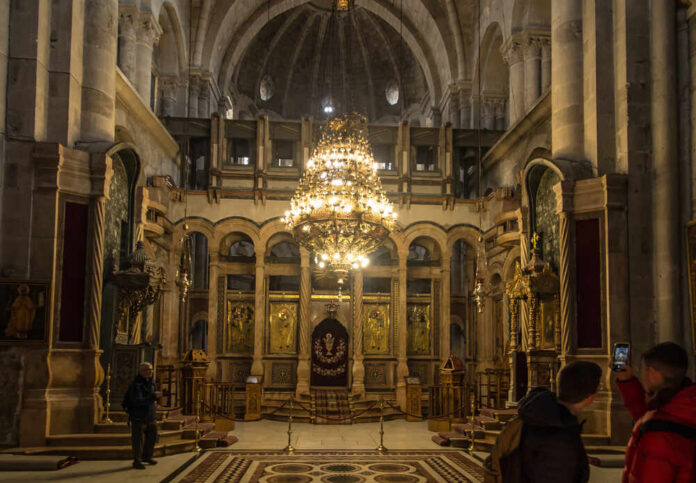
Soil beneath the Church of the Holy Sepulcher just gave the Gospel of John a concrete setting: a real garden beside a rock-cut tomb.
Story Snapshot
- Excavations under the church uncovered olive and vineyard traces consistent with a cultivated garden.
- Researchers say the area shifted from quarry to garden in the late Second Temple era.
- The find aligns with John 19:41’s note about a garden by the tomb, but does not prove the tomb’s identity.
- Scholars still debate the exact burial location, but many favor this site over the Garden Tomb.
What Was Found Beneath Christianity’s Holiest Address
Archaeologists working below the Church of the Holy Sepulcher pulled soil cores and sifted ancient fill. They found olive pollen and grape remains.
Those are classic markers of a tended plot, not a wasteland. The research team from Sapienza University documented the first formal pollen record from the basilica area and flagged olive among the arboreal species in multiple layers.
Church authorities also summarized the dig sequence: a limestone quarry later reclaimed as an agricultural garden with vines and olives.
The location lines up with a simple claim: the Gospel of John places a tomb “in a garden” near the crucifixion site. The new samples describe that exact kind of landscape. This does not certify the tomb’s identity. It does tighten the setting around the right time and place.
Good archaeology narrows possibilities. It rarely hands out signed nameplates. Still, when soil and Scripture point the same way, the idea is to pay attention.
Excavations beneath Jerusalem’s Holy Sepulchre reveal a burial landscape resembling New Testament descriptions. https://t.co/XytU9iBiB5
— Newsweek (@Newsweek) August 28, 2026
From Stone Quarry To Tended Garden
Excavation reports say the area began as an Iron Age quarry. Stone cutters carved out building blocks, then left the scarred pit behind. Later inhabitants filled it with soil and made it productive.
The Latin Patriarchate’s account notes the shift to agriculture, including vines and olives, confirmed by plant science specialists on the project. That sequence matches what we see across Jerusalem’s ridges. People worked marginal land hard, and nothing sat empty if it could bear fruit.
The botanical trail carries weight because olive pollen travels, but it does not appear everywhere by chance. Finding it within distinct occupational layers and alongside grape indicators points to cultivation rather than random drift.
The Sapienza notice frames the current results as preliminary, but it also calls them a rare window into the basilica’s paleoenvironment. That makes the “garden by a tomb” in this district a live, evidence-backed scenario, not a romantic gloss.
What This Means—And What It Doesn’t
This find strengthens the case that the church sits on ground that once held a gardened zone beside rock-cut tombs. Many archaeologists have already rated this site the better candidate when set against the Garden Tomb, which experts date to centuries before Jesus.
A 1993 report quoted archaeologist James Strange saying the “archaeological vote” goes to the Holy Sepulcher. A scholarly survey states the church’s authenticity cannot be refuted on archaeological grounds, which is careful language but significant.
Skeptics answer that no one can tag the exact burial spot with absolute certainty. That is true in a narrow sense. The Nelson University note puts it plainly: we cannot identify the tomb with full certainty. But this caution does not erase the new data. It sets proper bounds.
The garden evidence does not end the debate. It does remove a key objection that the Gospel’s detail was literary color. The ground itself now argues the detail was literal.
How To Weigh Claims Without Getting Spun
Media headlines rush to “proof.” Careful readers should resist that push. Look instead for specific, checkable items: pollen identified to olive, grape signals, and a clear quarry-to-garden sequence tied to the late Second Temple period.
Those appear in the project’s own materials and in the church’s technical summaries. That is the steel, not the sizzle. When a claim rests on testable findings and clear methods, it aligns with both sound science and prudence.
For decades the Garden Tomb attracted tourists as the site of Jesus’ crucifixion and burial. But the tombs there don’t date to the 1st century AD. The traditional site, the Church of the Holy Sepulchre, matches all the biblical details, and this excavation is in the “right spot.” https://t.co/uZXBCBlDIY pic.twitter.com/shCO9m2BvE
— Dinesh D'Souza (@DineshDSouza) August 28, 2026
Here is the bottom line. The soil under the Holy Sepulcher now shows signs of a cultivated garden by ancient tombs. That matches the Gospel’s setting detail. It does not stamp one tomb as “the” tomb. It does push the debate toward this site and away from alternatives that fail on dating or layout.
Facts first, then conclusions. On this round, the facts point to a garden where the church stands today—and that makes the story of that Passover weekend feel a step closer to the ground.
Sources:
archaeologymag.com, crosswalk.com, youtube.com, octagonproject.org, sacerdotus.com