
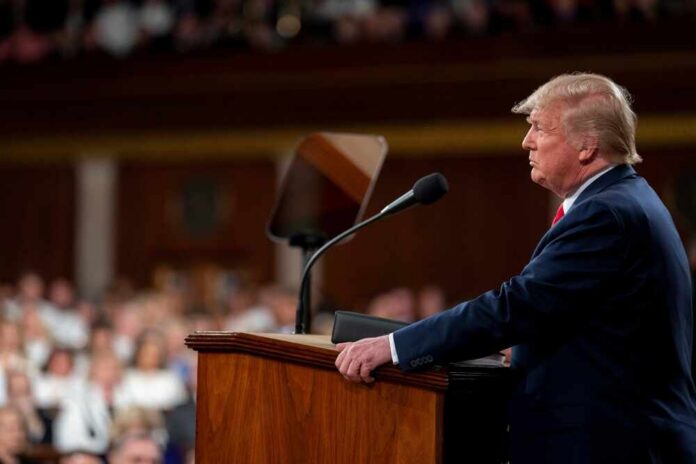
Only about one in three Americans approve of President Trump’s job performance, and the unease runs wide.
Story Snapshot
- Trump approval stands at 34%, with 66% disapproving
- Strong disapproval reaches 51%, a second-term high in this series
- Registered voters prefer Democratic control of Congress, 55% to 45%
- Republican favorability sits at 37% favorable, 63% unfavorable
Approval Slumps As Pessimism Hardens
NBC News reports that 34% of U.S. adults approve of President Trump’s job performance, while 66% disapprove. The intensity gap now defines the picture: 51% strongly disapprove, the high-water mark of his second term in this poll series. Numbers this lopsided signal more than a rough week. They reflect a fixed mood. The share of Americans who say the country is on the wrong track lines up with these ratings, and the vibe is not softening heading into the midterms.
Corroboration from other national surveys lands in the same range. Recent rounds from Washington Post–ABC News–Ipsos and Fox News place approval between 33% and 36%. Polls measure a moment, not fate, but when different pollsters with different methods cluster together, they point to a real headwind. Voters do not need to agree on causes to send a message. Low approval is the message. Midterms tend to echo it.
Independents Break Away, Base Intensity Erodes
The backbone of this slide is not a revolt among Republicans, who still back Trump at high levels, but a collapse among independents. NBC reports just 21% approval among independents, while approval among Republicans remains 76%. Even inside the party, the passion cooled before October. Strong approval among Republicans fell from 52% in spring to 41% by late summer, with more shifting into “somewhat approve” rather than leaving outright. Elections run on energy. Lukewarm support turns rallies into whispers.
This pattern lines up with a familiar rule in American politics: midterms often act as a referendum on the president. Scholars have shown that presidential approval colors House and Senate voting, though local races, incumbents, and turnout can bend the arc. Low approval is not destiny. It is gravity. Campaigns must work harder to defy it, especially when swing voters have tuned out a president’s case and view the opposition as a safer brake.
Generic Ballot Edge And A Party Brand Problem
Registered voters in the NBC survey prefer Democrats to control Congress by 55% to 45%. That spread, if it holds, gives Democrats room to compete in closely divided districts. Geography still matters. District lines decide how votes convert to seats. But a 10-point edge is not a rounding error; it is a map changer when paired with strong turnout operations. Republicans face a second drag: only 37% view the Republican Party favorably, while 63% view it unfavorably. A sour party brand makes candidate introductions harder and mistakes costlier.
From a conservative strategy lens, the fix starts with focus. Voters have made clear that they want steadier leadership and clear plans on cost of living, safety, and borders. Strong results on those fronts can reset opinions faster than any ad. The movement’s winning formula has always been competence plus conviction. When the brand reads chaos, independents walk. When it reads results, they come back.
What The Numbers Mean For November
Trends like these usually translate into House losses for the president’s party, yet politics still allows surprises. The late break can hinge on a single event, a debate clip, or a turnout jolt. One caution applies: national preference does not automatically settle Senate fights or governor’s races. Candidate quality, state economies, and local issues can overrule the national tide. Even so, with approval at 34% and strong disapproval at 51%, the tide is set against Republicans unless they change the conversation fast.
Three new polls put President Trump's approval at 33% to 36%, and Democrats lead the midterm ballot by 8 to 10 points.
Hold on. The ABC/Washington Post/Ipsos poll has Trump at 33%, a record low in that poll. NBC has him at 34% and Fox News at 36%. The Post poll has independents…
— TheJonathonPryce (@JonathonPryce1) October 19, 2026
Campaigns cannot wish away numbers. They can outwork them. Tighten the message to price, security, and schools. Stop the side shows that drain trust. Give independents a reason to split their tickets. The open lane is practical problem-solving that passes the kitchen-table test. American voters punish drama and reward steadiness. That is not a theory. It is the lesson the data is teaching right now.
Sources:
nbcnews.com, usatoday.com, news18.com, axios.com, onlinelibrary.wiley.com