The same Biden-era instincts that treated patriotic symbolism like a nuisance are being reversed—right down to the paint on America’s most visible aircraft.
Story Snapshot
- The U.S. Air Force is repainting presidential and VIP aircraft from the Kennedy-era “robin’s egg blue” scheme to a darker navy, deep red, and gold palette preferred by President Trump.
- The change is being applied across multiple aircraft types tied to executive transport, including platforms associated with Air Force One and Air Force Two missions.
- The Air Force began implementing the new livery requirement after Trump’s 2024 re-election, with public indications surfacing as aircraft cycle through scheduled maintenance.
- One C-32A has already emerged in the updated paint scheme, and Department of Homeland Security-related aircraft are also appearing in the new look.
A Fleet-Wide Shift Signals a Clear Break With the Biden Reversal
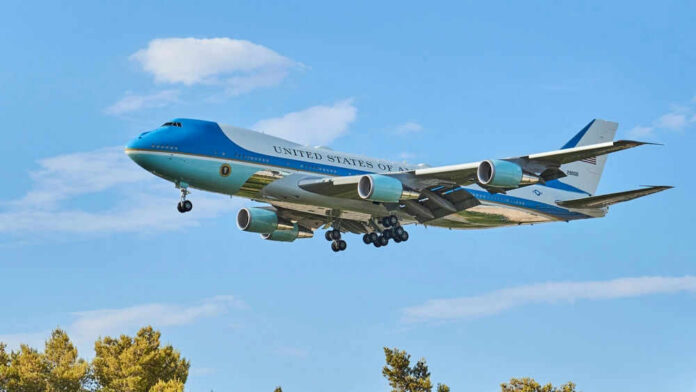
U.S. Air Force aircraft used for presidential and VIP travel are being repainted from the long-running Kennedy-era design into a new livery featuring dark navy, deep red, and gold. Reporting indicates the initiative is systematic rather than one-off, with aircraft receiving the new paint as they enter scheduled maintenance and repair cycles.
The result is a visible and immediate marker of a change in administration priorities after President Trump returned to office.
NEWS via @CBSNews: The Kennedy-era paint colors on the exterior of aircraft in the U.S. Air Force executive fleet are being replaced with new design in Trump's preferred palette. New Trump colors will appear on donated Qatari jet and two planes Boeing is converting to serve as…
— Jennifer Jacobs (@JenniferJJacobs) February 17, 2026
The repainting also represents a direct policy reversal of the Biden-era decision to abandon Trump’s earlier proposal and return to the classic light-blue look.
The Kennedy design originated in the early 1960s and is widely credited to designer Raymond Loewy, developed with encouragement from First Lady Jacqueline Kennedy. That historical continuity is part of why the change draws attention, but the current plan emphasizes a more overt red-white-and-blue identity.
What’s Been Spotted So Far—and How the Work Is Being Implemented
Aircraft watchers and defense reporters have documented at least one C-32A—often associated with “Air Force Two” missions—appearing in the updated scheme.
The aircraft was reported flying from Majors Airport in Greenville, Texas, after repainting work tied to a contractor facility, and it carried a red-white-and-blue treatment accented with gold lines and an American flag on the tail. The Air Force’s approach is to apply changes during scheduled downtime to avoid disrupting operations.
Reporting also indicates the design is not confined to a single Air Force platform. The livery requirement has been described as applying to multiple executive airlift aircraft, with references to Air Force One platforms, C-32 aircraft, and other government VIP transports.
Separately, Department of Homeland Security-linked aircraft have appeared wearing the new look, including a Boeing 737 Business Jet associated with DHS activity and Coast Guard aircraft receiving similar paint, suggesting broader standardization across executive travel fleets.
The Air Force One Modernization Backdrop: New Platforms, Old Delays
The paint story is unfolding alongside major modernization efforts that have drawn scrutiny for years: the conversion of Boeing 747-8 aircraft into the VC-25B fleet intended to serve as the next Air Force One platform.
While the reporting emphasizes livery, it also highlights how visual changes ride on top of long, complex procurement and modification timelines. The Air Force’s public messaging has pointed to implementation steps beginning in 2025 for the VC-25B livery requirement.
Another closely watched element is the reported refurbishment of a luxury 747-8 originally tied to Qatar, expected—based on cited reporting—to be ready for presidential use no later than summer 2026.
Some defense analysts have raised questions about the feasibility and requirements for any aircraft stepping into an Air Force One role, especially around communications, security, and mission-specific hardening. Those concerns are distinct from paint, but they underscore that appearance is only the final layer on a demanding national-security platform.
Symbolism vs. Spending: What We Know, and What’s Still Unanswered
The most common public pushback centers on cost, especially after years in which families absorbed inflation and fiscal turbulence. Available reporting does not provide a total price tag for fleet-wide repainting, nor does it outline a complete schedule for every aircraft affected.
What is documented is the method—rolling repainting during scheduled maintenance—which is designed to minimize operational disruption and avoid grounding aircraft solely for cosmetic changes.
Public reaction is also being measured as a matter of taste and national image. One cited poll found a plurality favoring the Trump red-white-and-blue approach over the vintage Kennedy-era scheme, while a smaller share preferred keeping the older look.
Trump has also publicly characterized the new colors as more representative of the United States, while acknowledging the nostalgia attached to the Jackie Kennedy-era palette. For supporters who value patriotic clarity over elite branding, the change is a straightforward signal of whose America is being represented.
Sources:
U.S. Air Force VIP fleet being repainted in Trump’s preferred palette, sources say
C-32A Air Force Two Jet Emerges Wearing Trump’s New Air Force One Paint Job
C-32A Air Force Two jet emerges wearing Trump’s new Air Force One paint job