President Trump just hit “pause” on a resumed bombing campaign against Iran—while keeping a U.S. blockade in place—creating a high-stakes standoff that could swing from diplomacy to conflict fast.
Quick Take
- Trump announced an indefinite extension of the U.S.-Iran ceasefire hours before the prior deadline was set to expire.
- The decision reversed Trump’s same-day comments indicating he expected bombing to resume if the ceasefire wasn’t extended.
- The U.S. is continuing a blockade of Iranian ports even as kinetic strikes remain paused, signaling “pressure without bombing.”
- Iran has not publicly acknowledged the extension, and key disputes—including uranium-related claims—remain unresolved.
Trump’s Indefinite Extension: A Sudden Pivot With Big Consequences
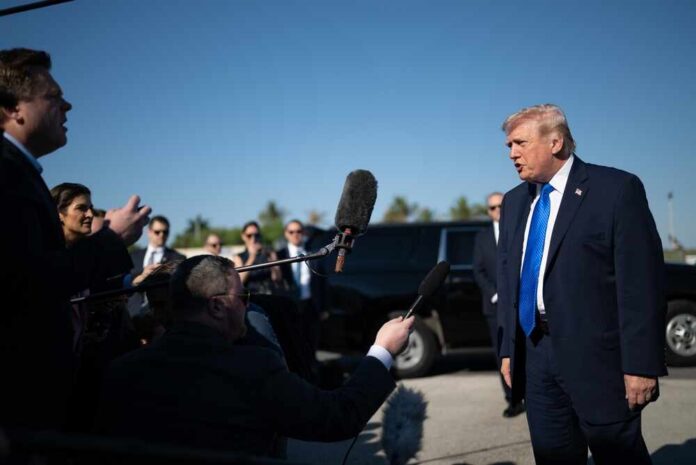
President Donald Trump announced Tuesday afternoon that the U.S. would extend the ceasefire with Iran indefinitely, a move that came only hours before the original two-week pause was set to end.
The timing stood out because Trump had signaled earlier that day he did not want to extend the deadline and expected strikes to restart. Trump said he granted more time after a request from Pakistan and cited Iran’s “seriously fractured” government as a key reason talks were stalled.
Trump’s message also made clear the ceasefire is not a full de-escalation. He said U.S. forces will continue a blockade and remain “ready and able,” preserving military leverage while delaying renewed bombing.
That hybrid posture matters because it keeps pressure on Iran’s economy and shipping while reducing immediate risk to U.S. forces and partners. It also leaves Americans with a familiar question: is this a bridge to a deal, or simply a temporary halt before the next escalation?
Blockade Continues as U.S. Forces Expand Maritime Operations
The administration’s posture is easier to understand when viewed as a maritime pressure campaign rather than a traditional ceasefire. Reports indicate the U.S. blockade of Iranian ports remains in effect and that naval operations have expanded outward, including into the Indian Ocean, where U.S. forces have boarded tankers previously sanctioned for smuggling Iranian oil.
Meanwhile, Iran reportedly fired at two ships in the Strait of Hormuz, underscoring how quickly disruption can spread in a corridor vital to global trade.
For markets and working families, the key takeaway is that the conflict’s economic fallout doesn’t require daily airstrikes to bite. Research notes that Iranian port closures have “rocked the global economy,” and uncertainty about how long this “indefinite” pause lasts can ripple through shipping schedules, insurance costs, and energy-related pricing.
Americans who already feel squeezed by years of inflation and high costs tend to notice when foreign crises add yet another layer of instability.
Mixed Signals on Negotiations: Uranium Claims and a “Unified Proposal” Problem
Trump framed the extension as a practical response to a messy negotiating environment, saying Iran needs time to produce a “unified proposal” before discussions can conclude. But the research also highlights major contradictions between U.S. statements and Iranian public positions.
Trump said Iran had “agreed to everything,” including a claim that the U.S. would “take” Iran’s enriched uranium, yet Iran’s Foreign Ministry contradicted that point. If core issues like uranium are disputed publicly, the pathway to a durable agreement looks uncertain.
Iran’s internal politics are another complicating factor. Trump argued Iran’s leadership is fragmented, which may slow decision-making and make enforcement harder even if a deal is reached.
From a limited-government, constitutional perspective at home, this is where accountability and clarity matter: open-ended military postures and ambiguous diplomatic end states can become expensive, long-running commitments. The reporting does not establish whether Iran and Israel will adhere to the extended ceasefire, leaving the public with limited visibility into enforcement.
Why This Matters Politically: Restraint, Leverage, and Public Trust
Domestically, Trump’s shift will be interpreted in sharply different ways. Supporters can point to a pause in bombing as restraint without surrender, since the blockade and military readiness remain in place. Critics can argue the reversal creates confusion and signals uncertainty.
The research includes skepticism from an adviser to Iran’s parliamentary speaker, who described the extension as a tactic to buy time for a possible surprise strike—an allegation that reflects distrust, but is not proven by the reporting provided.
INDEFINITE CEASEFIRE: Trump Extends Iran Ceasefire Indefinitely, In an About-Face pic.twitter.com/OMKzhe5O42
— SEGAMI (@segamihcfund) April 22, 2026
For many Americans—right, left, and independent—the deeper issue is credibility. Years of shifting narratives from Washington have conditioned voters to suspect that official messaging often masks internal disagreements or political calculation.
This episode adds to that atmosphere: the ceasefire is extended, but the blockade stays; negotiations are described as ongoing, but key claims are publicly disputed; and the endpoint is undefined. The best-supported fact from the research is that the policy is now open-ended, and open-ended policies have a way of testing public patience.
Sources:
Trump extending ceasefire in Iran indefinitely until discussions are concluded